
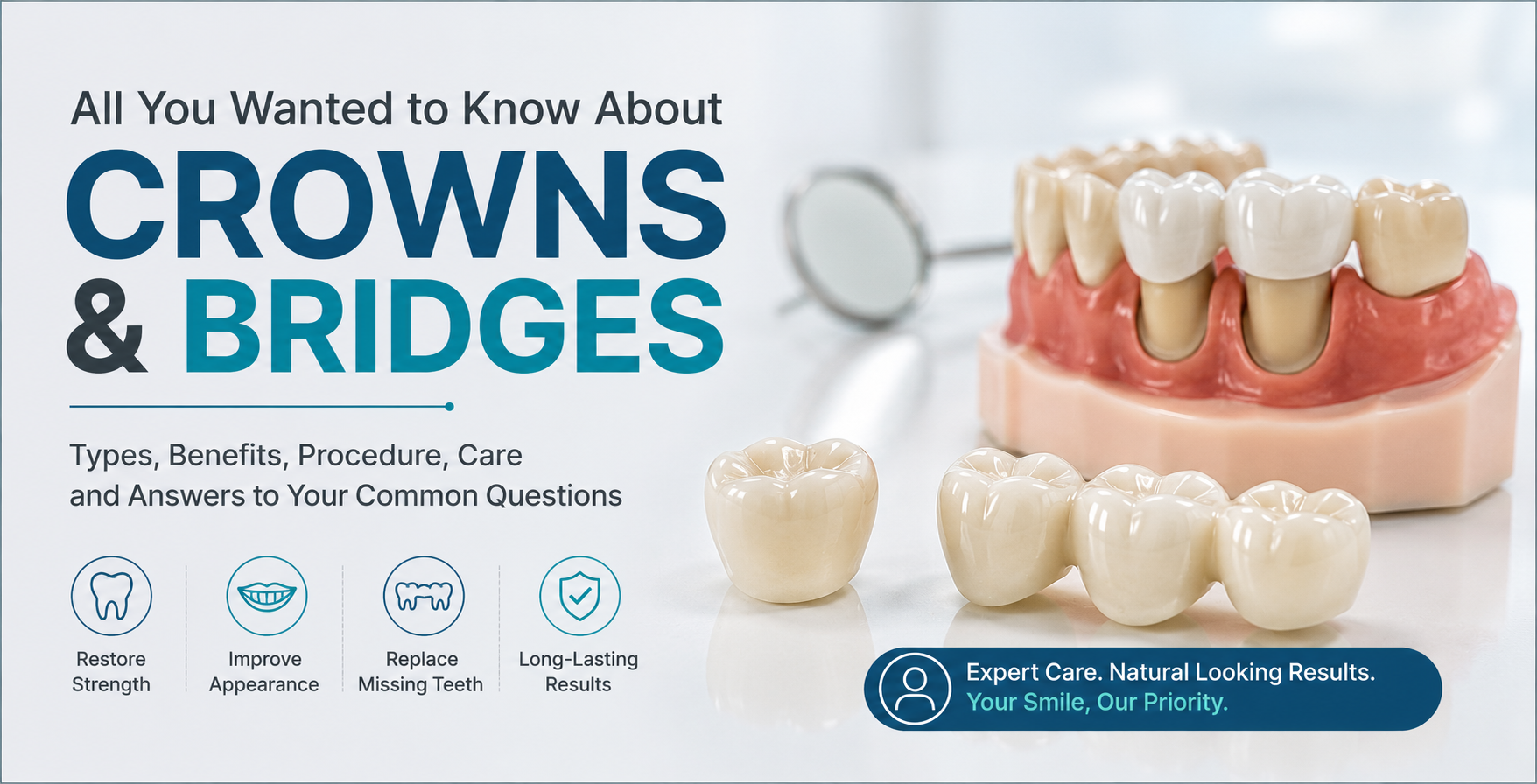
Crowns and bridges can restore damaged or missing teeth very effectively. But what happens when a crown keeps coming off, food gets trapped around a bridge, or a crown starts hurting after treatment?
These problems should not simply be treated by repeatedly replacing or cementing the crown or bridge.
The important question is:
Why did the problem happen in the first place?
Understanding the cause often helps us decide whether the existing crown or bridge can be repaired, needs to be replaced, or whether another treatment option should be considered.
21. Why does my crown keep coming off?
A crown that repeatedly comes off is usually a sign that something needs to be investigated.
There can be several reasons:
- The tooth underneath may have become weakened or damaged.
- There may be decay under or around the crown.
- The tooth may not have enough healthy structure to properly support the crown.
- The crown may not fit correctly.
- The bite may be putting excessive force on the crown.
- You may be clenching or grinding your teeth.
- The cement may have failed because of moisture, contamination or other factors.
- The crown or the tooth may have fractured.
So, should the crown simply be cemented back every time it comes off?
Not necessarily.
If a crown has come off repeatedly, the tooth and the crown should be carefully examined to find out why it is happening.
Sometimes the existing crown can be reused.
Sometimes a new crown is required.
And sometimes the tooth itself may need additional treatment before a new crown can be considered.
The important point
A crown repeatedly coming off is a symptom, not the diagnosis.
Finding the reason for the failure is more important than simply putting the crown back.
22. Why does food get stuck around my crown or bridge?
Food getting stuck around a crown or bridge can happen for several reasons.
There may be:
- A gap or incorrect contact between teeth
- A problem with the shape of the crown
- Changes in the gum or bone around the tooth
- Gum recession
- Movement of the supporting tooth
- A bridge design that makes cleaning difficult
- Changes in the neighbouring teeth
A small amount of food occasionally getting trapped is not necessarily a sign that the crown is defective.
However, persistent food trapping in the same place should be evaluated.
Why?
Because food accumulation can make cleaning difficult and may contribute to gum inflammation, bad breath or decay around the restoration.
What should I do?
Do not simply keep pushing food out with sharp objects.
Your dentist can check the contact between the teeth, the shape of the crown or bridge and the condition of the surrounding gums.
Sometimes a simple adjustment is enough.
Sometimes the restoration needs to be redesigned or replaced.
23. Why does my crown smell or taste bad?
A bad smell or unpleasant taste around a crown or bridge is not something that should simply be ignored.
It may be related to:
- Food getting trapped
- Plaque accumulation
- Gum inflammation
- Decay around the crown
- Leakage around an old restoration
- A problem with the tooth underneath
- Difficulty cleaning underneath a bridge
- Infection in the tooth or surrounding tissues
The crown itself does not normally “produce” a bad smell.
The smell usually comes from bacteria, trapped food, inflammation or infection around or underneath the restoration.
What should I do?
Your dentist should examine both the restoration and the tissues around it.
Depending on the cause, treatment may involve improved cleaning, professional cleaning, adjustment, repair, replacement of the crown or bridge, or treatment of the underlying tooth.
Do not assume that changing the crown alone will solve the problem unless the cause has been identified.
24. Why is my tooth sensitive even after getting a crown?
Some sensitivity after a crown can occur, particularly during the initial period after treatment.
The tooth may react to:
- Cold
- Hot
- Sweet foods
- Pressure
This does not automatically mean that something has gone wrong.
However, persistent, worsening or severe sensitivity needs to be evaluated.
Possible reasons include:
- The nerve inside the tooth is irritated
- The tooth was already affected before the crown was placed
- The bite is too high
- There is decay or leakage
- The tooth has developed inflammation of the nerve
- The tooth has cracked or fractured
- There is a problem with the surrounding gum or tooth structure
Sometimes simply adjusting the bite solves the problem.
In other situations, the nerve may require treatment.
The important point
A crown covers the tooth, but it does not remove the nerve inside it.
Therefore, a crowned tooth can still develop nerve problems.
25. Why does my crown hurt when I bite?
Pain when biting after a crown is placed should be assessed rather than ignored.
One common reason is that the crown may be slightly high in the bite.
Even a very small difference can make the tooth receive excessive pressure when you close your mouth.
An adjustment of the bite may solve the problem.
However, pain on biting can also be caused by:
- Inflammation of the tooth nerve
- A crack or fracture
- Infection around the root
- Problems with the supporting tissues
- A loose or defective crown
- Excessive biting forces
If the pain continues after a simple bite adjustment, the tooth should be investigated further.
What if the crown was fitted several months ago and has only recently started hurting?
That is also worth investigating.
A tooth can develop a problem months or even years after a crown has been placed.
The crown may still look perfectly normal from the outside.
26. Why has the gum around my crown become dark or swollen?
Dark or swollen gums around a crown can have several causes.
Swelling may be related to:
- Plaque accumulation
- Gum inflammation
- Food trapping
- An over-contoured crown
- Difficulty cleaning around the crown
- Decay
- Infection
A dark line near the gum may sometimes be related to the material used for the crown, particularly with older metal-containing restorations.
But a dark area should not automatically be assumed to be “just the metal.”
Other possibilities include:
- Gum recession exposing the underlying tooth or restoration
- Inflammation
- Changes in the gum tissue
- The underlying tooth becoming darker
- Problems with the crown margin
Can the gum become healthy again?
Often, yes — if the underlying cause can be identified and treated.
Sometimes improving oral hygiene and professional cleaning is enough.
In other cases, the crown itself may need adjustment or replacement.
The important point
Healthy gums are an important part of a good crown.
A beautiful crown sitting next to unhealthy gums is not a successful long-term result.
27. How long should a good dental crown last?
There is no guaranteed lifespan for a dental crown.
A well-designed and properly maintained crown can function for many years, but its longevity depends on much more than the crown material.
Factors include:
- Condition of the tooth underneath
- Quality of the crown
- Fit and design
- Bite
- Oral hygiene
- Gum health
- Tooth grinding or clenching
- Diet and habits
- Regular dental maintenance
- The amount of remaining natural tooth structure
A crown can fail because the tooth underneath it fails, even if the crown itself is still intact.
Similarly, a crown may remain functional for many years but eventually require replacement because of wear, decay, gum changes or other problems.
Does an expensive crown last forever?
No.
Price and material alone do not determine longevity.
The quality of the diagnosis, tooth preparation, crown design, laboratory work, bite and long-term maintenance all matter.
28. Should an old bridge be replaced or should I consider implants?
This is not a decision that should be made based simply on the age of the bridge.
The first question is:
Why does the existing bridge need attention?
The supporting teeth should be examined carefully.
The dentist may need to assess:
- The condition of the supporting teeth
- Gum and bone health
- Decay around the bridge
- Root canal treatment, if present
- The fit of the bridge
- The condition of neighbouring teeth
- The number and location of missing teeth
- The patient’s bite and chewing forces
If the supporting teeth are healthy and the bridge is otherwise suitable, replacing the bridge may be reasonable.
If the supporting teeth have become compromised, dental implants may provide another option.
However, implants are not automatically better simply because a bridge is old.
What is the basic difference?
A traditional bridge generally uses neighbouring teeth to support the replacement tooth or teeth.
A dental implant is designed to replace the missing tooth’s root and can support a crown or other restoration without relying on neighbouring natural teeth in the same way.
So which should I choose?
The correct question is not:
“Bridge or implant — which is better?”
It is:
“Which option is most appropriate for the condition of my teeth, gums, bone, bite and long-term needs?”
29. Why do some crowns look artificial while others look like natural teeth?
A crown can be technically successful and still not look natural.
Why?
Because natural-looking dentistry involves much more than simply choosing a white colour.
The appearance of a crown depends on:
- Tooth shape
- Size
- Colour
- Translucency
- Surface texture
- Position
- Gum relationship
- Bite
- The neighbouring teeth
- How light reflects from the crown
The dentist and dental laboratory also need to understand what the surrounding natural teeth look like.
For front teeth especially, small differences can become noticeable.
Is the whitest crown the most natural?
Not necessarily.
Natural teeth usually contain variations in colour, translucency and texture.
A very opaque or extremely white crown can sometimes look less natural than a carefully matched restoration.
What makes a crown look natural?
The goal should be to make the crown blend with the surrounding teeth, rather than simply making it stand out as a new artificial tooth.
30. Zirconia, ceramic or metal-ceramic crown — which is actually better?
This is one of the most common questions patients ask.
The simple answer is:
There is no single crown material that is best for every tooth and every patient.
Different materials have different strengths and limitations.
Zirconia crowns
Zirconia is a strong ceramic material and can be used in a variety of situations.
It is particularly useful where strength is important.
Modern zirconia can also provide good aesthetics, although different types of zirconia have different optical properties.
All-ceramic crowns
These can provide excellent aesthetics and are often particularly attractive for visible teeth.
Different ceramic systems have different characteristics, so “ceramic” is not one single material.
Metal-ceramic crowns
These have a metal substructure covered by tooth-coloured ceramic.
They have been used successfully for many years and can provide good strength and function.
However, in some situations, the metal substructure may contribute to a darker appearance near the gum, particularly if the gum recedes.
So Which Crown Material Should I Choose?
Instead of asking:
“Which material is the best?”
ask:
“Which material is best for this particular tooth?”
The decision may depend on:
- Whether the tooth is in the front or back
- Amount of remaining tooth structure
- Bite
- Available space
- Aesthetic requirements
- Gum position
- Tooth colour
- Functional forces
- Presence of grinding or clenching
- Overall treatment plan
A crown for a front tooth may have very different requirements from a crown on a heavily loaded back tooth.
Does the material matter?
Yes.
But it is only one part of the equation.
A very expensive material cannot compensate for poor diagnosis, inadequate tooth preparation, an incorrect bite, poor fit or inadequate maintenance.
What Makes a Good Crown or Bridge?
A successful crown or bridge should not be judged only by how it looks on the day it is fitted.
It should ideally provide:
Good function
Good fit
Healthy surrounding gums
Appropriate bite
Good aesthetics
Easy maintenance
Long-term protection of the underlying teeth
This is why the planning stage is so important.
When Should I Replace an Old Crown or Bridge?
An old restoration does not automatically need replacement simply because it is old.
If it is functioning well, fits properly, the surrounding gums are healthy and the underlying teeth are sound, it may not need to be replaced immediately.
Replacement may become necessary if there is:
- Decay
- Fracture
- Poor fit
- Recurrent food trapping
- Gum problems
- Repeated loosening
- Significant wear
- Aesthetic deterioration
- Problems with the supporting tooth
The decision should be based on condition and prognosis, not age alone.
Can a Crown Be Repaired Instead of Replaced?
Sometimes.
It depends on what has gone wrong.
A minor chip may sometimes be repaired.
A loose crown may sometimes be recemented if the tooth and crown are otherwise healthy.
However, if there is decay underneath, a fracture, poor fit or another underlying problem, simply repairing the visible part may not solve the real issue.
The goal should be:
Treat the cause, not repeatedly repair the symptom.
Can a Tooth With a Crown Still Get Decay?
Yes.
A crown covers much of the tooth, but it does not make the tooth immune to decay.
Decay can develop around the edges of the crown or in exposed tooth structure.
This is why brushing, cleaning between teeth and regular dental examinations remain important even after a crown has been placed.
Can a Crowned Tooth Still Need Root Canal Treatment?
Yes.
The nerve inside a tooth remains alive unless it has been removed through root canal treatment.
A tooth may sometimes develop nerve inflammation or infection after a crown has been placed.
This does not necessarily mean the crown was poorly made.
The tooth may have already had underlying damage, or the nerve may become affected later.
The situation needs to be assessed before deciding what treatment is required.
Does Getting a Crown Mean the Tooth Is Fixed Forever?
No.
A crown is designed to restore and protect a tooth, but it cannot guarantee that the tooth will never develop another problem.
The tooth underneath remains part of your body and can still be affected by:
- Decay
- Fracture
- Gum disease
- Infection
- Excessive bite forces
This is why a crowned tooth still needs proper care and regular monitoring.
How Can I Make My Crown or Bridge Last Longer?
There are several practical things you can do.
1. Maintain good oral hygiene
Brush carefully and clean between the teeth every day.
2. Pay attention to the gum margins
Plaque around the edge of a crown can contribute to gum problems and decay.
3. Avoid using your teeth as tools
Do not use crowns or bridges to open packages or bite extremely hard objects.
4. Address grinding or clenching
If you grind your teeth, discuss it with your dentist.
5. Attend regular check-ups
Your dentist can detect problems before they become major failures.
6. Do not ignore repeated problems
If your crown repeatedly comes loose, food constantly gets trapped or the gum keeps swelling, find out why.
The Bottom Line About Crowns & Bridges
A crown or bridge is not simply a piece of material placed over or between teeth.
It is part of a larger biological and functional system involving:
The tooth
The gums
The supporting bone
The bite
The restoration
Your oral hygiene
Your long-term maintenance
So when something goes wrong, the solution should not always be:
“Let’s replace the crown.”
Sometimes the crown is the problem.
Sometimes the tooth underneath is the problem.
Sometimes the bite is the problem.
Sometimes the gums are the problem.
And sometimes the original treatment plan needs to be reconsidered.
The most important principle is simple:
A good crown is not just one that looks good when it is fitted. It is one that fits well, functions well, protects the tooth, maintains healthy gums and can be properly maintained over the years.
Can a broken tooth always be saved with a crown?
No. A broken tooth cannot always be saved with a crown.
Whether a tooth can be restored depends mainly on how much healthy tooth remains and where the fracture has occurred.
A crown may be appropriate when enough sound tooth structure remains to support it.
However, if the fracture extends deep below the gum or into the root, the tooth may not have a predictable long-term prognosis.
Other factors also matter, such as:
- Whether the tooth is infected
- Whether the root is fractured
- How much healthy tooth remains
- The condition of the gums and supporting bone
- The patient’s bite and chewing forces
Sometimes a broken tooth can be restored with a filling or other restoration rather than a crown.
Sometimes additional treatment, such as root canal treatment or a procedure to expose more healthy tooth structure, may be required before a crown can be considered.
And sometimes, unfortunately, the tooth may not be safely restorable.
The important point
A crown is not a way of “holding any broken tooth together.”
The first question should always be:
“Can this tooth be predictably saved?”
When is a crown better than a filling?
A filling and a crown serve different purposes.
A filling is generally used when enough healthy tooth structure remains and the tooth can still be adequately restored without covering the entire tooth.
A crown may be considered when a tooth has lost a significant amount of its structure and needs greater protection.
For example, a crown may be appropriate when there is:
- Extensive decay
- A large existing filling
- A significantly fractured tooth
- A heavily weakened tooth
- A root canal-treated tooth where substantial tooth structure has been lost
But a crown is not automatically better simply because it is stronger.
If a tooth can be predictably restored with a conservative filling or other restoration, unnecessarily removing more healthy tooth structure to place a crown may not be desirable.
So which is better?
The aim should be:
Use the least invasive treatment that can provide a predictable long-term result.
Does every root canal-treated tooth need a crown?
No. Not every root canal-treated tooth automatically needs a crown.
The decision depends on the particular tooth and how much healthy tooth structure remains.
A back tooth that has lost a large amount of structure may require a crown or another form of cuspal protection because it is exposed to significant chewing forces.
A front tooth with relatively little loss of tooth structure may sometimes be restored without a conventional crown.
The decision depends on:
- Which tooth has been treated
- How much tooth structure remains
- Whether the tooth has fractured
- Its functional demands
- The patient’s bite
- The type of restoration required
The important point
Root canal treatment removes infection or treats the nerve inside the tooth.
It does not automatically mean that the tooth must be crowned.
The tooth still needs to be assessed to determine the most appropriate final restoration.
Can a crown be placed without a root canal?
Yes.
A root canal is not required simply because a tooth is receiving a crown.
In fact, many crowned teeth have healthy, living nerves.
A crown may be required because the tooth is:
- Heavily damaged
- Fractured
- Worn
- Decayed
- Supporting a large existing restoration
- Requiring protection for functional or aesthetic reasons
Root canal treatment is generally considered when the nerve inside the tooth is irreversibly inflamed, infected or otherwise requires treatment.
Does putting a crown cause the need for a root canal?
Not necessarily.
A well-planned crown can be placed on a tooth with a healthy nerve.
However, a severely damaged tooth may already have an underlying nerve problem that needs to be identified before or during treatment.
The crown and root canal are two different treatments for two different problems.
How much tooth needs to remain for a crown?
There is no single percentage or measurement that applies to every tooth.
What matters is whether there is enough healthy tooth structure to provide a stable foundation for the crown.
The dentist needs to consider:
- The amount of remaining tooth structure
- The height and shape of the tooth
- Where the remaining structure is located
- The condition of the root
- Gum and bone support
- The bite and chewing forces
- Whether the tooth can be properly cleaned after restoration
Sometimes a tooth that appears badly broken can still be restored.
At other times, a tooth that looks reasonably intact may have a deep fracture or other problem that makes restoration unpredictable.
Can more tooth structure be exposed if there isn’t enough?
In selected situations, additional procedures may help expose healthy tooth structure so that a restoration can be properly supported.
However, this is not suitable for every tooth.
The important principle
The question is not simply “How much tooth is left?”
It is:
“Is there enough healthy tooth structure to give the tooth a predictable long-term prognosis?”
What happens if the tooth under my crown breaks?
This can be worrying, but the first step is not automatically to remove the crown.
The tooth and crown need to be assessed to determine what has fractured and how extensive the damage is.
Possible situations include:
- A small fracture that can be restored
- Decay weakening the remaining tooth
- A fracture below the gum
- A root fracture
- Loss of tooth structure due to repeated biting forces
- A previously weakened tooth becoming further damaged
Depending on the situation, treatment may involve:
Repair → new crown → additional treatment → or, if the tooth cannot be predictably saved, removal and replacement.
Sometimes the existing crown may even remain usable, depending on what has happened underneath it.
The important point
A crown protects a tooth, but it cannot make the underlying tooth unbreakable.
If a crowned tooth suddenly becomes loose, painful or broken, it should be examined promptly.
Can a bridge be made without cutting healthy teeth?
A conventional dental bridge usually requires the supporting teeth to be prepared so that the bridge can be securely fitted.
However, not every bridge design requires the same amount of tooth preparation.
Depending on the situation, alternatives may include:
- Adhesive or resin-bonded bridges
- Implant-supported restorations
- Other conservative tooth-replacement options
Whether a conservative bridge is suitable depends on the location of the missing tooth, the bite, available support and the condition of the neighbouring teeth.
What if the neighbouring teeth are completely healthy?
This is one of the situations where dental implants may be worth considering because an implant can replace the missing tooth without requiring conventional preparation of adjacent natural teeth.
However, implants are not suitable or necessary for everyone.
The treatment should be planned around the patient’s overall situation rather than simply choosing the least number of procedures.
Are dental implants better than bridges?
Not necessarily.
Dental implants and bridges are different ways of replacing missing teeth, and each has advantages and limitations.
A conventional bridge uses neighbouring teeth for support.
A dental implant is placed into the jaw and can support a crown without relying on neighbouring natural teeth in the same way.
Implants may be particularly attractive when:
- Adjacent teeth are healthy
- The patient wants an independent replacement
- Suitable bone and gum conditions are present
- The patient is medically suitable for implant treatment
A bridge may be preferable when:
- The neighbouring teeth already require crowns
- Implant placement is unsuitable
- The patient prefers a different treatment approach
- The overall treatment plan makes a bridge more appropriate
So which is better?
Instead of asking:
“Are implants better than bridges?”
the better question is:
“Which option gives this particular patient the most predictable long-term result?”
Can an old bridge be converted to an implant-supported restoration?
Sometimes, but not usually by simply converting the existing bridge.
If a bridge has reached the end of its useful life, the entire situation should be reassessed.
The dentist may evaluate:
- The missing tooth area
- The supporting teeth
- Bone availability
- Gum condition
- Bite
- The number of missing teeth
- The condition of the existing bridge
If the supporting teeth have become compromised, implants may offer a way to replace the missing teeth without continuing to rely on those teeth.
In some cases, implants can be placed and a new implant-supported restoration designed.
Does that mean the old bridge can simply be attached to implants?
Usually, no.
An implant-supported restoration generally needs to be specifically designed for the implants, their position and the patient’s bite.
So it is better to think of this as:
“Replacing the old bridge with an implant-supported solution”
rather than simply converting the old bridge.
How do I clean underneath a dental bridge?
Cleaning under a bridge is extremely important because the artificial tooth cannot be removed for routine cleaning.
Food and plaque can accumulate underneath the bridge and around the supporting teeth.
Depending on the bridge design, cleaning may involve:
- Dental floss
- Super floss or floss threaders
- Interdental brushes
- Special cleaning aids
- A water flosser, when appropriate
Your dentist or hygienist can show you exactly how to clean your particular bridge.
Why is this so important?
The bridge may look completely normal from above while plaque is accumulating underneath it.
The supporting teeth and gums still need protection.
A simple rule
If you have a bridge, cleaning underneath it should be part of your daily routine.
Why does my bridge keep breaking?
A bridge that repeatedly breaks needs investigation.
Possible causes include:
- Excessive biting forces
- Teeth grinding or clenching
- Inadequate support
- Weak or damaged supporting teeth
- Poor design
- Fracture of the supporting tooth
- Problems with the bite
- Material limitations
- The bridge being too long for the available support
Simply making another bridge without understanding why the previous one failed may result in the same problem happening again.
What if the bridge has broken more than once?
This is a good reason to stop and reassess the treatment plan.
Sometimes the solution may be a different bridge design.
Sometimes an implant-supported restoration may be more appropriate.
Sometimes the supporting teeth themselves need treatment first.
Repeated failure is a reason to investigate the cause, not simply repeat the treatment.
Why is there a gap between my crown and gum?
A visible gap between the crown and gum can develop for different reasons.
Sometimes the gum has naturally receded, exposing more of the tooth or crown margin.
Other possibilities include:
- Gum disease or inflammation
- Changes in the gum after the crown was placed
- Incorrect crown contour
- A crown margin that does not fit appropriately
- Changes in the underlying tooth
A small visible change does not automatically mean the crown is defective.
However, if there is food trapping, sensitivity, bleeding, swelling or decay, the area should be examined.
Can the gap be corrected?
That depends on the cause.
Sometimes improving gum health is enough.
Sometimes the crown needs adjustment or replacement.
In certain aesthetic situations, gum treatment may also be considered.
The cause should be identified before deciding how to correct it.
Can my crown be whitened if my natural teeth are whitened later?
No — the crown itself cannot be whitened in the same way as natural teeth.
Teeth whitening works on natural tooth structure.
Most crowns and other tooth-coloured restorations do not respond to conventional whitening treatment.
This is particularly important when a crown is being planned for a visible front tooth.
What if I want whiter teeth?
Ideally, if you are considering teeth whitening and also need a new visible crown, discuss the whitening before the final crown shade is selected.
Your natural teeth can be whitened first, and the new crown can then be made to match the desired shade.
What if I already have a crown and later whiten my teeth?
The natural teeth may become lighter while the crown remains the same colour.
This can make the crown more noticeable.
If the colour difference becomes unacceptable, replacing the crown may be considered.
This is why the timing of whitening and cosmetic crown treatment matters.
What should I do if my crown comes off?
First, don’t panic.
Keep the crown safely rather than throwing it away.
Do not try to permanently glue it back using household glue or other adhesives.
If possible:
- Rinse the crown gently.
- Keep it in a clean container.
- Avoid chewing hard foods on that side.
- Keep the exposed tooth clean.
- Contact your dentist.
Your dentist can examine both the crown and the tooth underneath.
Sometimes the crown can be recemented.
Sometimes the crown needs repair or replacement.
And sometimes the tooth underneath has developed a problem that needs treatment before a new crown can be placed.
What if the crown is not painful?
Even if there is no pain, it is worth getting it checked.
A tooth may have significant decay or structural damage without causing immediate pain.
How quickly should I see my dentist if a crown comes off?
Ideally, contact your dentist as soon as reasonably possible.
A crown that has come off is not necessarily an emergency requiring immediate hospital treatment, particularly if you have no severe pain or swelling.
However, delaying for weeks is not a good idea.
The exposed tooth may be vulnerable to:
- Sensitivity
- Further damage
- Decay
- Fracture
- Movement of the neighbouring teeth
- Changes that may make the original crown difficult to refit
If you have severe pain, facial swelling, fever, significant bleeding or difficulty swallowing or breathing, seek urgent dental or medical care.
The practical rule
A loose or fallen crown should be assessed promptly — even if it doesn’t hurt.
A Simple Way to Think About Crowns & Bridges
When something goes wrong with a crown or bridge, it is tempting to ask:
“Can you just fix it?”
But a better question is:
“Why did it happen?”
A crown that keeps coming off, a bridge that repeatedly breaks, food that constantly gets trapped, or a tooth that hurts underneath a crown may all be telling us something about the underlying tooth, gums, bite or restoration.
Good dentistry is not just about replacing the restoration.
It is about understanding the tooth, supporting tissues, bite, function, aesthetics and long-term prognosis and then choosing the most appropriate solution.
That is what helps turn a temporary repair into a predictable long-term treatment.