
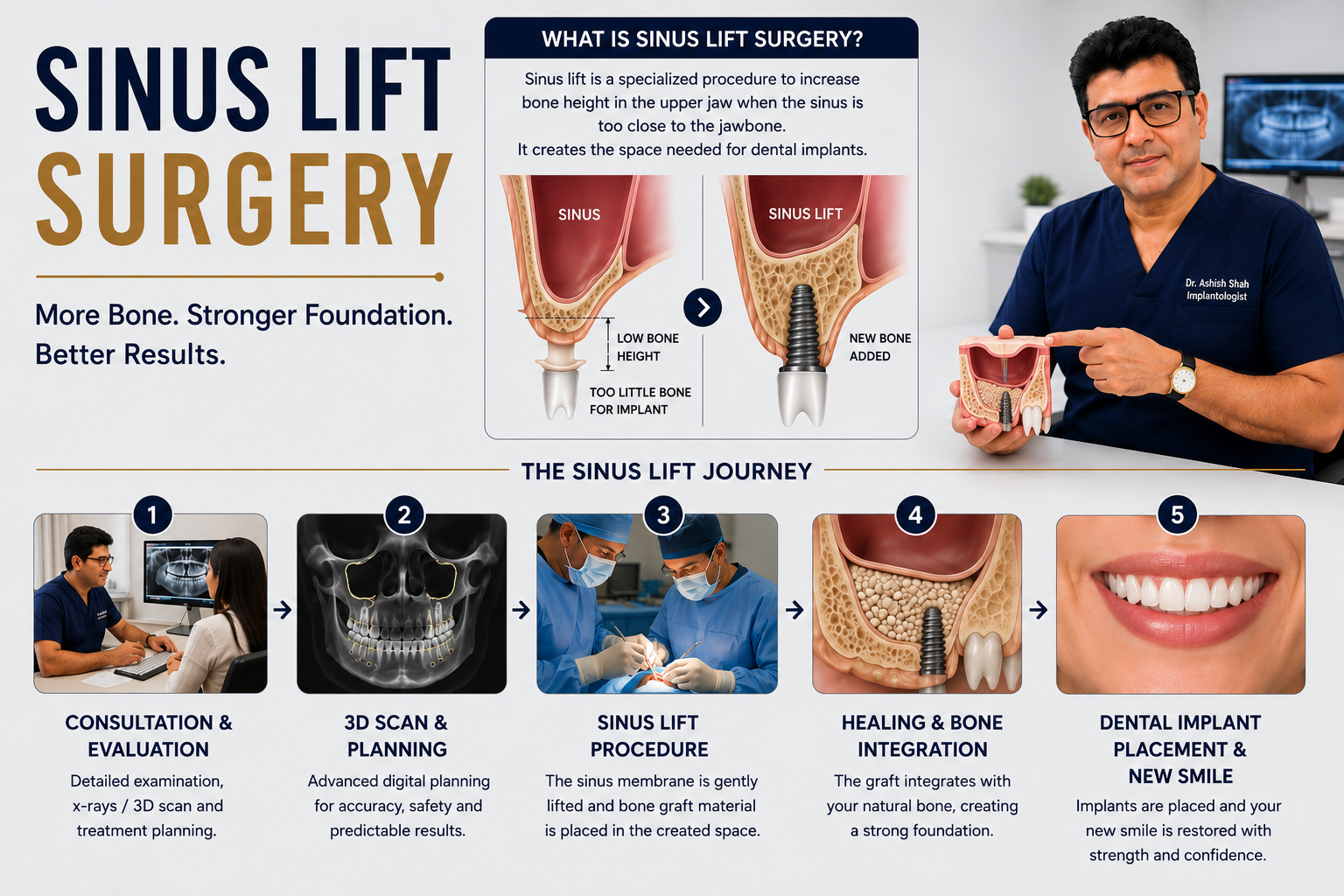
All You Wanted to Know About Sinus Lift Surgery
Do you need a dental implant in the upper back teeth region but have been told that there is “not enough bone”?
This is a very common situation.
You may have lost an upper molar or premolar many years ago and now want to replace it with a dental implant. But when your dentist examines you, your X-ray or CBCT scan may show that there is not enough bone height to safely place an implant.
Does this mean that you cannot have an implant?
Not necessarily.
In many patients, the available bone can be increased with a procedure called Sinus Lift Surgery, also known as Sinus Floor Elevation.
But what exactly is a sinus lift? Why does the bone become insufficient in the first place? How is the bone increased? Is it painful? What materials are used? And perhaps most importantly — how much experience does the implant surgeon need to perform this procedure safely?
Let us explore these questions together.
Why is there sometimes not enough bone for an implant?
When an upper back tooth is lost, the bone that once supported the tooth can gradually reduce in height and volume.
At the same time, the maxillary sinus, which is an air-filled cavity located above the upper back teeth, may occupy more of the space that was previously occupied by the tooth roots.
As a result, the vertical height of bone available for placing a dental implant may become insufficient.
The important point is that the sinus itself is not necessarily a problem.
The challenge is:
How can we create enough healthy bone between the mouth and the sinus to provide a stable foundation for an implant?
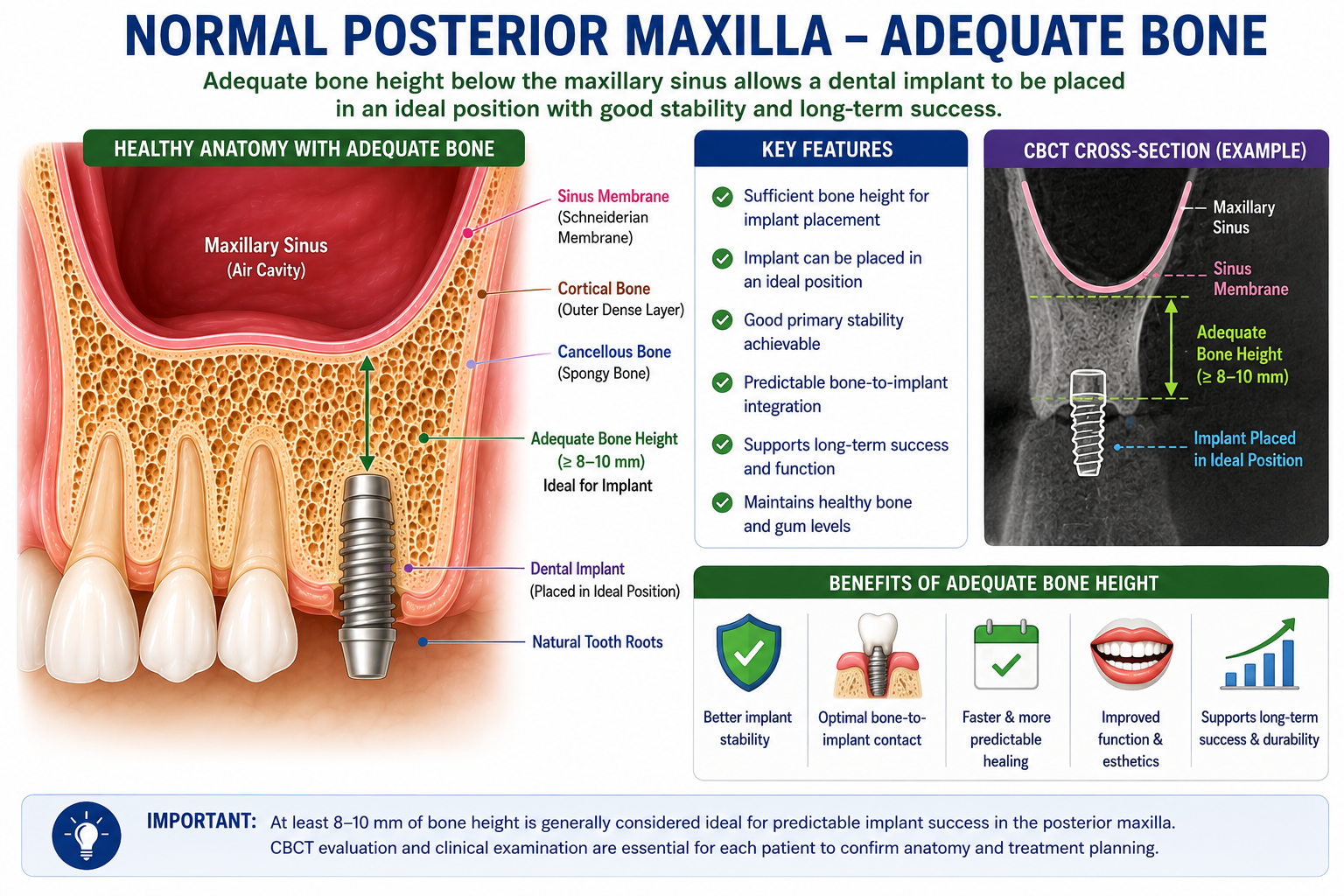
This illustration shows adequate bone height below the maxillary sinus, allowing a dental implant to be placed in an appropriate position.
What happens when the bone height is reduced?
Imagine that an upper molar has been missing for several years.
Over time, the bone may become thinner and shorter. In some patients, there may be only a few millimetres of bone remaining.
Trying to place a conventional implant without adequate bone support may therefore be inappropriate.
This is where sinus lift surgery may become an important part of implant treatment planning.
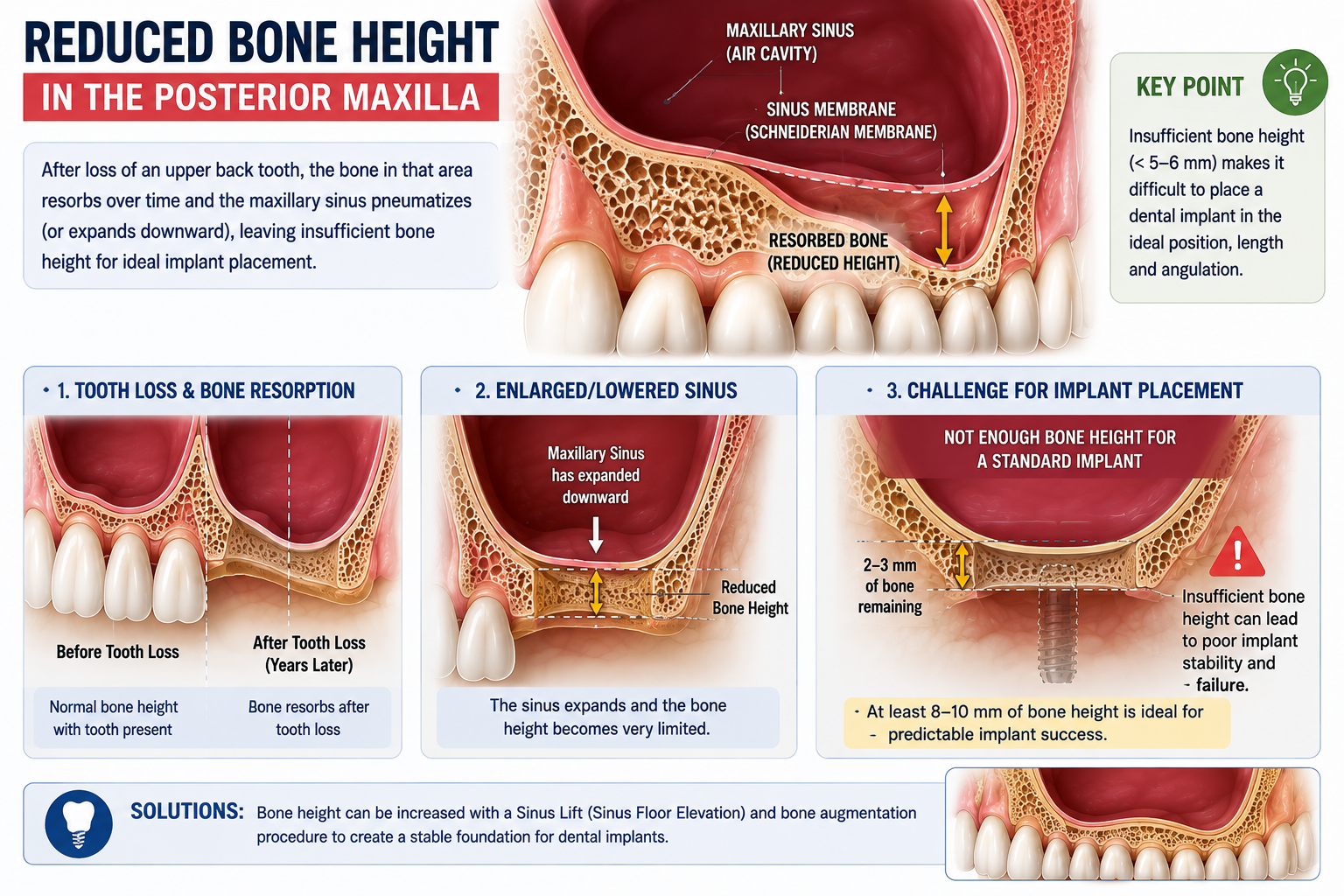
After loss of an upper back tooth, bone resorption and changes in the sinus can leave inadequate bone height for ideal implant placement.
What exactly is a sinus lift?
A sinus lift is a surgical procedure in which the delicate lining of the maxillary sinus is carefully elevated so that additional bone-grafting material can be placed beneath it.
The objective is simple:
To increase the available bone height and create a suitable biological foundation for dental implant placement.
The sinus lining is a delicate membrane. Therefore, the procedure requires:
- Careful diagnosis and planning
- Appropriate imaging
- Knowledge of sinus anatomy
- Appropriate surgical instruments
- Fine surgical technique
- Experience in managing the sinus membrane
- Understanding of bone biology and healing
It is not simply a matter of “adding some bone”.
The entire procedure needs to be planned around the patient’s individual anatomy.
How does sinus lift surgery actually increase the bone?
The basic principle can be understood in three steps.
1. There is insufficient bone height
The sinus is relatively close to the area where the implant needs to be placed.
2. The sinus membrane is carefully elevated
The delicate membrane lining the sinus is gently lifted away from the floor of the sinus.
3. Bone-grafting material is placed underneath the elevated membrane
This creates additional space in which new bone formation and maturation can occur.
Depending upon the clinical situation, the implant may sometimes be placed simultaneously, while in other cases the augmented area may require a period of healing before implant placement.
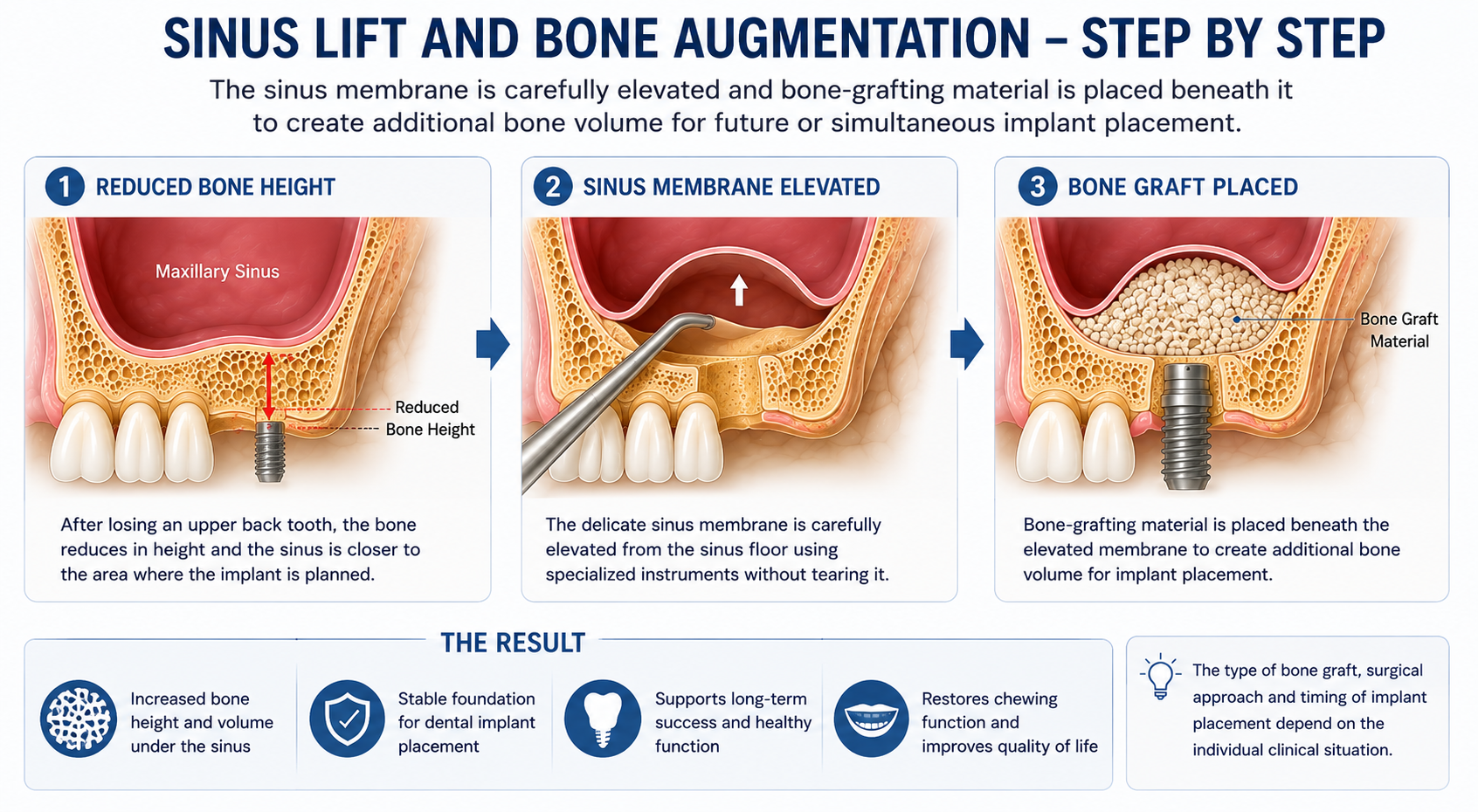
Reduced bone height → sinus membrane carefully elevated → bone-grafting material placed beneath the membrane to create additional bone volume for future or simultaneous implant placement.
Does a sinus lift mean that the sinus is damaged or removed?
Absolutely not.
This is one of the common concerns patients have.
The sinus is not removed.
The procedure involves carefully elevating the thin membrane lining the sinus away from the floor of the sinus and creating additional space underneath it for bone augmentation.
The goal is:
To create additional bone beneath the sinus while preserving the sinus membrane.
This is why knowledge of the anatomy and experience with the procedure are so important.
Are there different types of sinus lift procedures?
Yes.
Broadly, sinus augmentation can be performed using different surgical approaches depending upon:
- The amount of bone already present
- The amount of additional bone required
- The position of the implant
- The anatomy of the sinus
- The condition of the sinus membrane
- The number of implants required
- The overall treatment plan
The two commonly discussed approaches are:
1. Transcrestal Sinus Lift
A transcrestal approach is generally considered when the existing bone height and clinical situation are suitable for a more limited elevation.
Access is made through the area where the implant is planned. The sinus floor is carefully approached and the membrane is elevated to the required extent.
In selected cases, the implant may be placed during the same procedure.
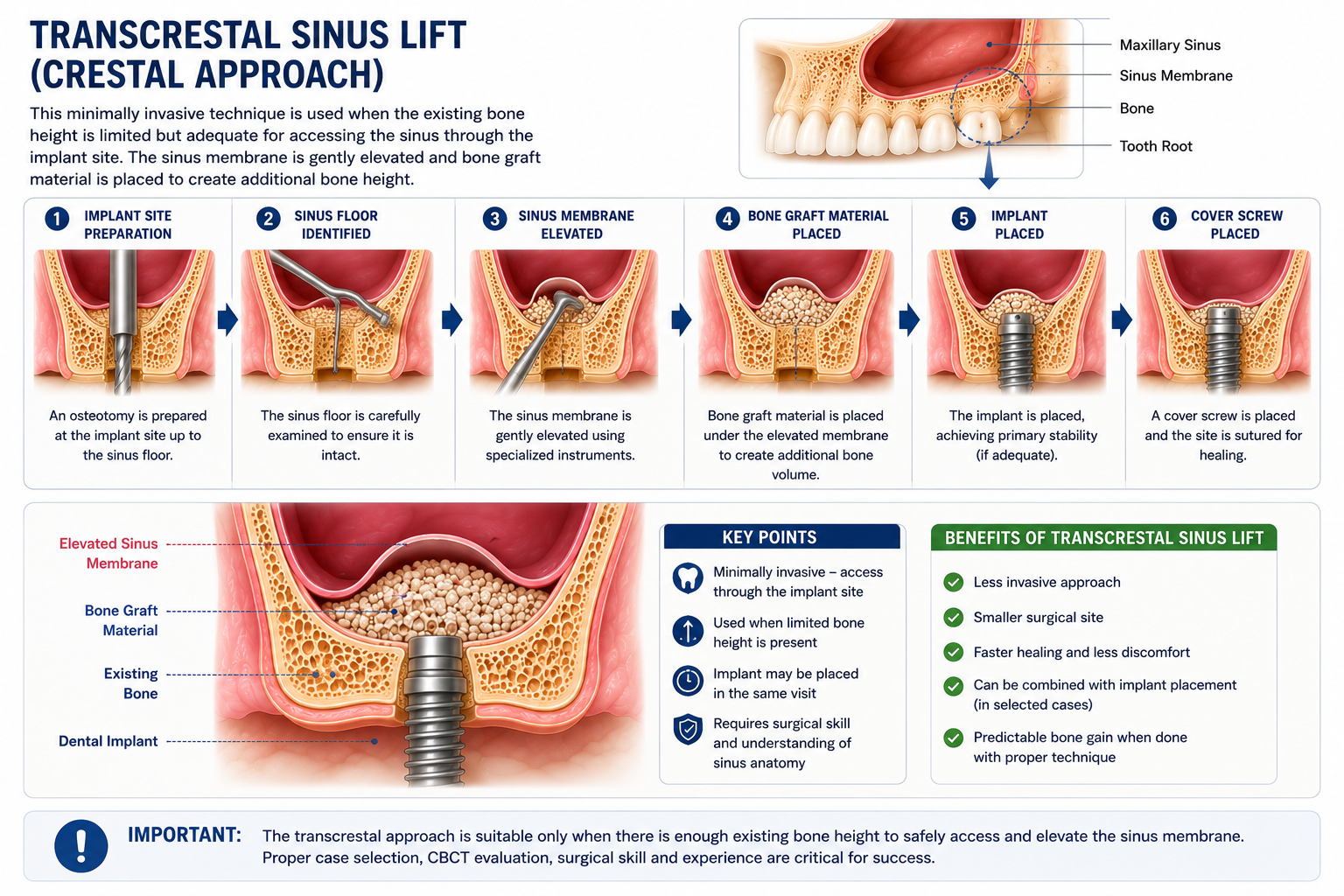
Access is obtained through the implant site, the sinus membrane is carefully elevated, bone-grafting material may be introduced, and the implant may be placed when clinically appropriate.
2. Lateral Window Sinus Lift
When considerably more bone augmentation is required, a lateral-window approach may be appropriate.
In this technique, a carefully designed access window is created in the side wall of the upper jaw.
The sinus membrane is gently elevated, and bone-grafting material is placed beneath it.
Depending upon the amount and quality of existing bone and other clinical factors, the implant may be placed either simultaneously or after a period of healing.
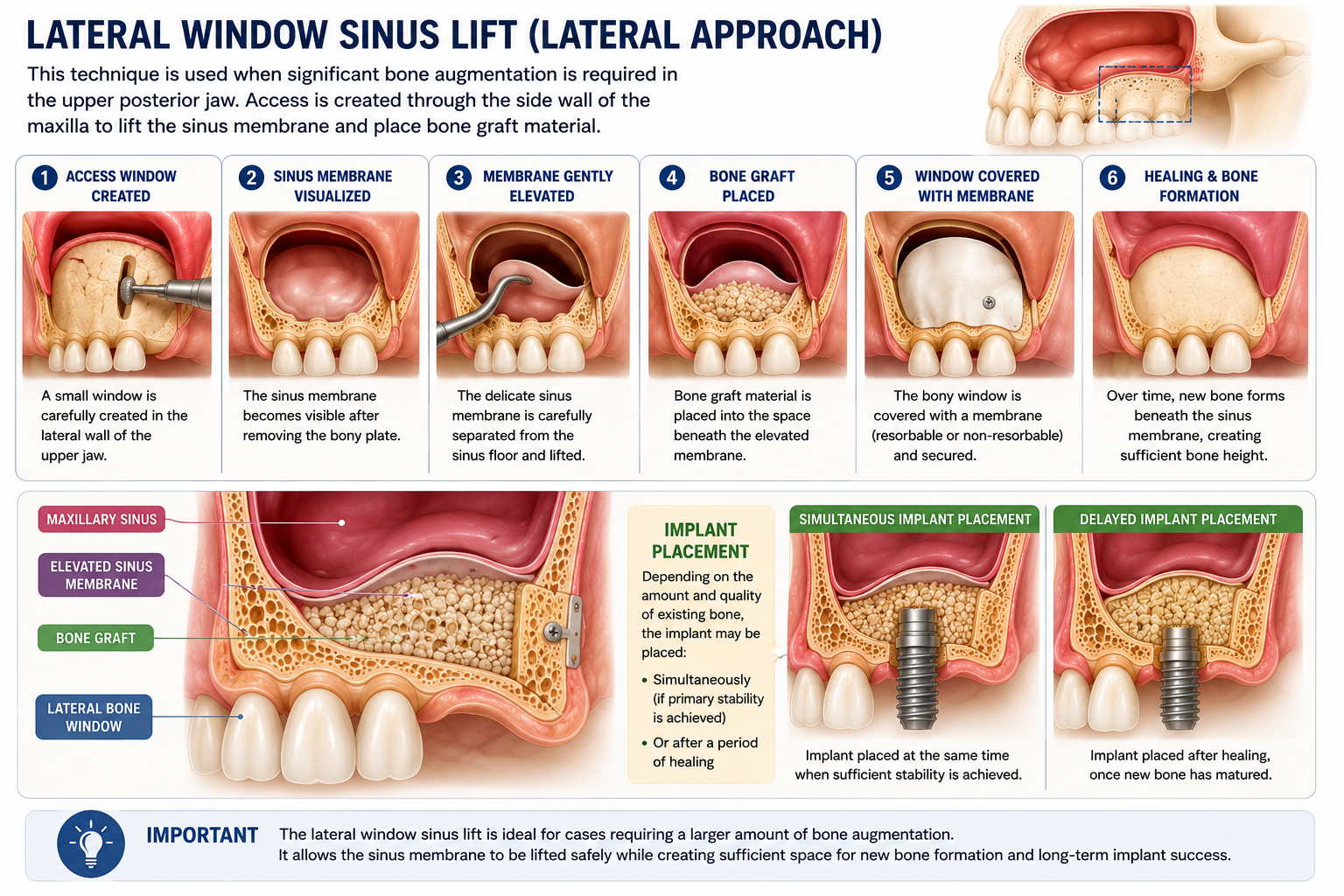
The lateral-window technique provides access through the side wall of the upper jaw and may be used when a greater amount of sinus augmentation is required.
What material is used to create the new bone?
This is another question patients commonly ask:
“What exactly are you putting inside my sinus area?”
Bone-grafting materials can include different types of materials depending upon the patient’s anatomy, clinical requirements and treatment plan.
These may include:
Autologous Bone
Bone obtained from the patient’s own body.
Autologous bone has important biological advantages because it is the patient’s own tissue.
Allograft
Processed bone-grafting material obtained from a human donor source and prepared for clinical use.
Other Bone-Grafting Materials
Depending upon the individual clinical situation, other grafting materials or combinations may also be considered.
The important point is that the choice should not be based simply on the name or brand of the material.
The real question is:
Which grafting approach is biologically and clinically appropriate for this particular patient?
What is Bio-Engineering and how can it help?
Modern implant dentistry is not simply about placing an implant.
The biological environment in which the implant is placed is extremely important.
Depending upon the individual case, biological approaches may be incorporated into treatment to support tissue healing and regeneration.
At our practice, these may include:
- PRF — Platelet-Rich Fibrin
- i-PRF — Injectable Platelet-Rich Fibrin
- PRGF — Plasma Rich in Growth Factors
- Autologous bone
- Allograft materials
- Appropriate combinations of regenerative materials when clinically indicated
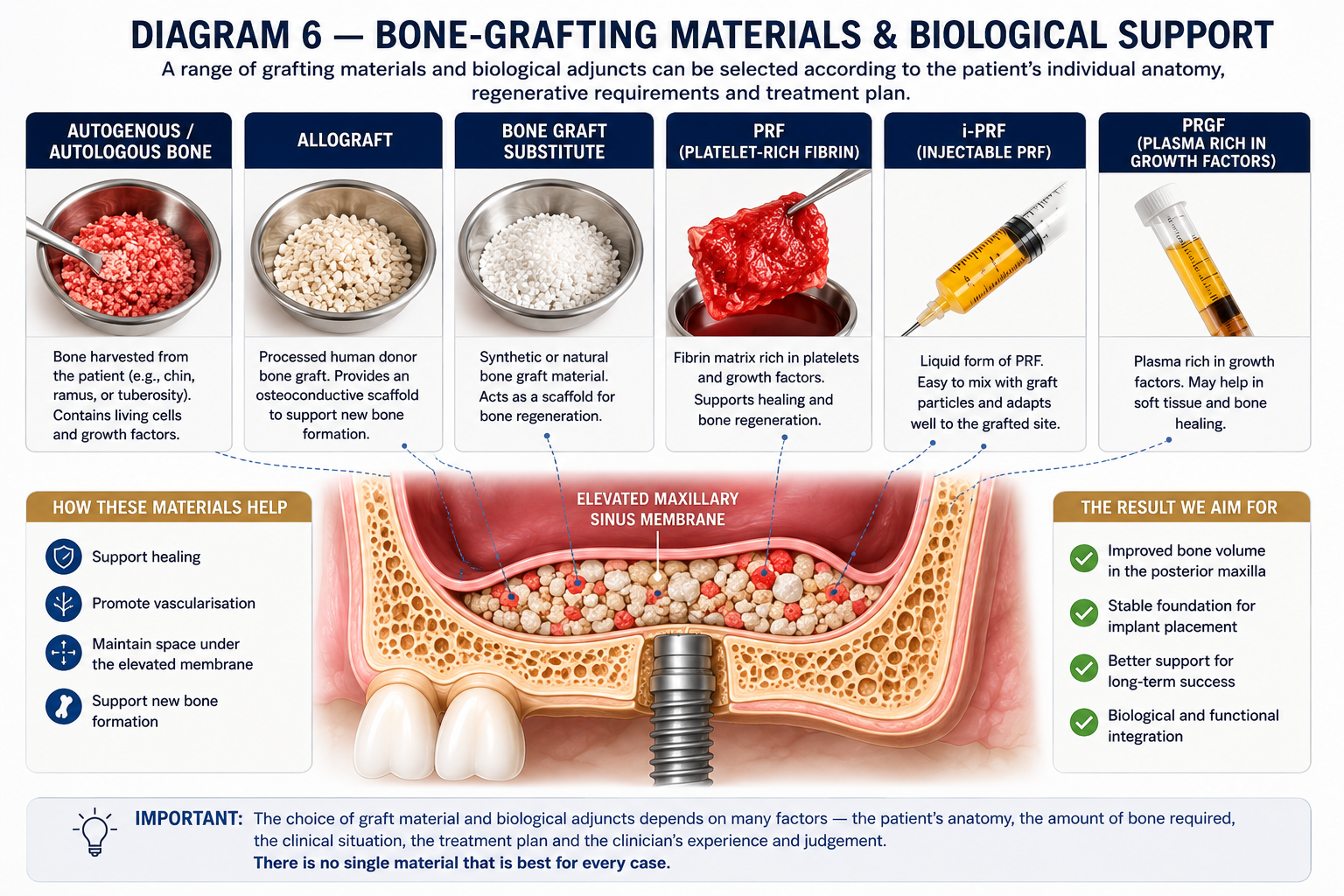
Bone-grafting materials and biological adjuncts can be selected according to the patient’s individual anatomy, regenerative requirements and overall treatment plan.
The objective is not to use every available material.
The objective is to select the right biological and regenerative approach for the individual patient.
Why does CBCT matter so much before a sinus lift?
A sinus lift should never be approached as a routine “one-size-fits-all” procedure.
Before sinus augmentation, the anatomy needs to be carefully evaluated.
A CBCT scan can provide valuable three-dimensional information about:
- Available bone height
- Bone width
- Sinus anatomy
- Sinus septa
- Condition of the sinus membrane
- Position of important anatomical structures
- Implant position
- Amount of augmentation required
This information allows the treatment to be planned rather than performed by guesswork.
Three-dimensional CBCT assessment helps the clinician understand the patient’s individual anatomy and plan sinus augmentation and implant placement more precisely.
What does sinus lift surgery actually feel like?
One of the first questions patients ask is:
“Will it hurt?”
The procedure is performed under appropriate local anaesthesia, so the surgical procedure itself should not be painful.
Patients may experience pressure, vibration or a feeling of movement during certain stages of treatment, but this is different from pain.
After surgery, there may be some swelling, tenderness or discomfort.
The exact experience varies from patient to patient and depends upon the extent of the procedure.
You will also be given appropriate postoperative instructions and medication when required.
How long does a sinus lift take to heal?
There is no single healing period that applies to every patient.
The timeline depends upon:
- The amount of augmentation performed
- The quality and quantity of existing bone
- Whether the implant was placed simultaneously
- The grafting materials used
- Individual healing characteristics
- Overall oral and systemic health
- The stability achieved during implant placement
Therefore, the healing period should be decided after assessing the individual case, rather than promising the same timeline to everyone.
Is sinus lift surgery safe?
When appropriately planned and performed by a trained and experienced clinician, sinus augmentation can be a predictable part of implant treatment.
However, like every surgical procedure, it is not completely free from complications.
One of the important challenges is the delicate sinus membrane.
Careful imaging, proper case selection, appropriate instruments and surgical experience are therefore extremely important.
What happens if the sinus membrane gets perforated?
The sinus membrane is delicate, and membrane perforation is a recognised potential complication of sinus augmentation.
The management depends upon:
- The size and location of the perforation
- The condition of the membrane
- The amount of augmentation required
- The clinical circumstances
- The surgeon’s experience and judgement
A surgeon who performs these procedures regularly is better prepared to recognise and manage such situations appropriately.
This is one reason why experience matters considerably in sinus lift surgery.
Is sinus lift surgery necessary for every patient who has insufficient bone?
No.
Not every patient with reduced bone height requires a sinus lift.
Depending upon the individual anatomy, other treatment options may sometimes be possible.
The correct decision can only be made after appropriate clinical examination and imaging.
The important question is not:
“Can I avoid a sinus lift?”
It is:
“What is the safest and most predictable way of creating a stable foundation for my implant?”
Why is experience so important in sinus lift surgery?
This is perhaps one of the most important things patients should understand.
Not every dentist who places dental implants is trained or experienced in performing sinus lift surgery.
Implant dentistry involves much more than placing an implant into bone.
Sinus augmentation requires a detailed understanding of:
- Maxillary sinus anatomy
- Sinus membrane biology
- Bone biology
- Surgical access
- Grafting principles
- Implant positioning
- Three-dimensional CBCT planning
- Management of anatomical variations
- Recognition and management of complications
- Long-term implant prosthetic planning
A sinus lift may become a relatively routine procedure for an implant surgeon who performs it regularly — but that does not mean that it is a simple procedure.
Routine for the experienced surgeon does not mean insignificant for the patient.
Dr Ashish Shah’s Experience with Sinus Lift Surgery
At our practice, sinus lift surgery forms part of a comprehensive approach to advanced implant dentistry and full-mouth rehabilitation.
Dr Ashish Shah has performed hundreds of sinus lift procedures, making sinus augmentation a familiar and routinely performed procedure within his implant practice.
With experience comes familiarity with different anatomical situations, variations in sinus anatomy, different degrees of bone deficiency and the challenges that may arise during surgery.
The treatment philosophy is therefore not simply:
“Can we place an implant?”
It is:
“How can we create the right biological and functional foundation for a predictable, healthy and long-lasting implant?”
The Dr Ashish Shah Approach to Sinus Lift Surgery
Every case begins with careful diagnosis and treatment planning.
1. Detailed Clinical Evaluation
Understanding your oral health, medical history, previous dental treatment and specific concerns.
2. CBCT-Based 3D Diagnosis
Evaluating the available bone, sinus anatomy and other important structures in three dimensions.
3. Individualised Treatment Planning
Determining whether a sinus lift is required and, if so, which approach is appropriate.
4. Bone Augmentation
Using an appropriate combination of grafting materials and biological approaches according to the individual case.
5. Surgical Expertise
Performing the procedure with careful handling of the sinus membrane and surrounding tissues.
6. Implant Placement
Placing the implant at the appropriate stage based on the available bone and biological stability.
7. Prosthetic Rehabilitation
Restoring the implant with an appropriate crown, bridge or other prosthetic solution.
8. Long-Term Maintenance
Ensuring that the implant and surrounding tissues are monitored and maintained over the long term.
What does the patient really need to look for?
If you have been told that you do not have enough bone for an upper back-tooth implant, don’t panic.
And don’t make your decision simply on the basis of:
“Who can give me the cheapest implant?”
Instead, ask:
✔ Has my case been evaluated with appropriate 3D imaging?
✔ What is the actual reason for the reduced bone height?
✔ Do I really need a sinus lift?
✔ Which type of sinus lift is appropriate for me?
✔ What grafting material is being proposed — and why?
✔ Can the implant be placed at the same time or will healing be required first?
✔ What experience does the surgeon have with sinus augmentation?
✔ How are possible complications managed?
✔ What is the complete treatment plan from sinus augmentation to the final tooth?
These questions can help you make a much more informed decision.
The Most Important Thing to Remember
A sinus lift should not be looked at as simply “adding bone.”
It is about creating the right biological environment for an implant.
The success of treatment depends upon multiple factors:
✔ The patient’s anatomy
✔ The sinus anatomy
✔ The available bone
✔ The treatment plan
✔ The surgical technique
✔ The grafting protocol
✔ The biological environment
✔ The implant position
✔ The prosthetic restoration
✔ Long-term maintenance
And ultimately, the experience and judgement of the clinician performing the procedure.
Have You Been Told That You Don’t Have Enough Bone for an Implant?
Don’t assume that this means dental implants are impossible.
At the same time, don’t assume that a sinus lift is automatically the answer.
The right approach begins with proper diagnosis and planning.
With appropriate CBCT evaluation, careful treatment planning, surgical expertise and modern regenerative approaches, many patients with reduced bone height in the upper back teeth region can be successfully rehabilitated with dental implants.
The objective is not simply to place an implant.
The objective is to create the right biological and functional foundation for a predictable, healthy and long-lasting result.
Frequently Asked Questions About Sinus Lift Surgery
Is a sinus lift painful?
The procedure is performed under appropriate local anaesthesia. You should not experience pain during the surgery, although pressure and other sensations may be felt. Some swelling or discomfort may occur during healing.
Can an implant be placed at the same time as a sinus lift?
Sometimes, yes. This depends primarily on the amount and quality of existing bone and the stability that can be achieved. In other situations, it is safer to allow the augmented area to heal before placing the implant.
How long does a sinus lift take?
The duration depends on the type of procedure, the amount of augmentation required, the number of implants and the individual anatomy.
How long before I get my final teeth?
There is no universal timeline. Your treatment may involve different stages of augmentation, healing, implant placement and prosthetic rehabilitation. Your individual CBCT findings and clinical situation determine the appropriate sequence.
Can a sinus lift fail?
As with any surgical procedure, complications are possible. Careful diagnosis, appropriate case selection, surgical technique and experience can help minimise risks and improve predictability.
Can I have a sinus lift if I have very little bone?
In many cases, significant bone deficiencies can be managed with appropriate augmentation. However, the feasibility and technique depend on the individual anatomy and sinus condition.
Does everyone who performs dental implants perform sinus lifts?
No.
Implant placement and sinus augmentation are related but distinct areas of surgical expertise. A clinician may place implants regularly without routinely performing advanced sinus augmentation procedures.
When a sinus lift is required, it is important to understand the clinician’s specific training and experience with the procedure.
Why is CBCT important?
CBCT provides three-dimensional information that cannot be obtained adequately from a conventional two-dimensional X-ray alone. It helps evaluate the available bone, sinus anatomy, membrane condition and other anatomical factors before surgery.
A Final Word
If you have been told:
“There isn’t enough bone for an implant.”
don’t immediately assume that the treatment ends there.
There may be a way to create the required bone foundation.
But the decision should be based on science, anatomy, experience and careful planning — not on a predetermined treatment.
Let’s first understand your anatomy, then understand your options, and finally decide what is appropriate for you.
Dr. Ashish Shah
Advanced Implant Dentistry • Bone Augmentation • Full Mouth Rehabilitation
With extensive experience in implant dentistry and hundreds of sinus lift procedures performed, sinus augmentation has become a routine part of advanced implant treatment at our practice.
The goal is not simply to place an implant.
The goal is to create the right biological and functional foundation for a predictable, healthy and long-lasting result.