
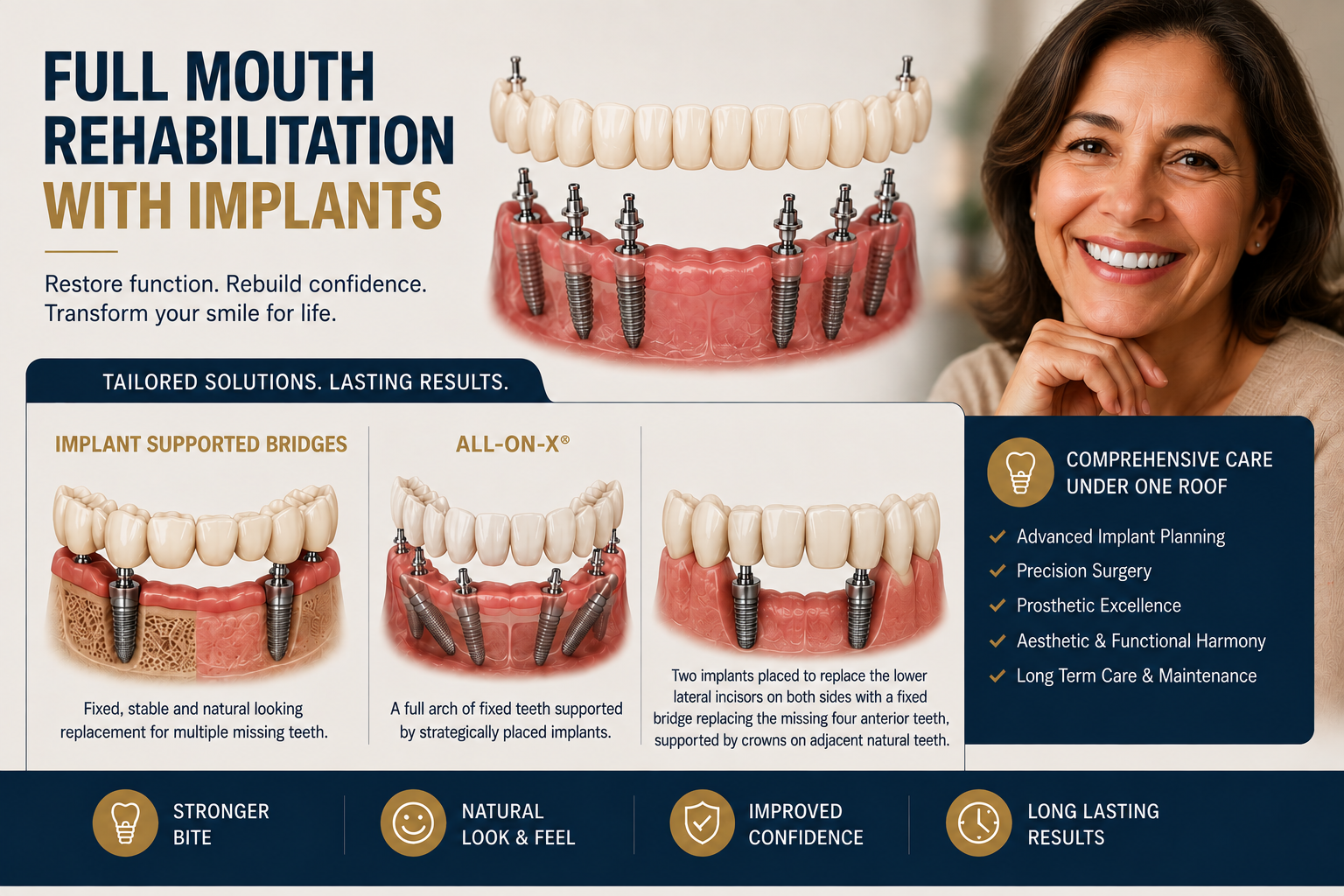
FULL-ARCH REHABILITATION WITH DENTAL IMPLANTS
A Complete Patient Guide to Replacing or Rehabilitating an Entire Arch of Teeth
Have you lost most of your teeth? Are several of your remaining teeth loose, broken or repeatedly failing? Are you struggling with chewing, or does your denture move when you eat or speak?
You may have heard about full-arch dental implants, All-on-4, All-on-6, All-on-X, fixed teeth on implants and other treatment options.
But which one is right for you?
The answer does not start with choosing an implant treatment.
It starts with understanding the condition of your teeth, gums, bone, bite and overall mouth.
A comprehensive approach is called full-arch rehabilitation.
The aim is not simply to replace missing teeth. The aim is to restore function, comfort, appearance, stability and long-term oral health in a way that is appropriate for you.
What Is Full-Arch Rehabilitation?
Full-arch rehabilitation means planning the treatment of an entire upper or lower dental arch as one functional unit.
It may be needed when most of the teeth are missing or when many of the remaining teeth have a poor long-term prognosis.
Depending on the condition of your mouth, treatment may involve:
- Saving and restoring natural teeth
- Dental implants
- Crowns and bridges
- A combination of natural teeth and implants
- Implant-supported removable teeth
- Fixed full-arch teeth supported by implants
So, does full-arch rehabilitation automatically mean removing all your teeth and placing implants?
No.
The treatment should be based on your individual condition.
Why Might I Need Full-Arch Rehabilitation?
You may need comprehensive treatment when you have several problems affecting an entire arch, such as:
- Multiple missing teeth
- Loose teeth
- Advanced gum disease
- Severely damaged teeth
- Repeatedly failing crowns or bridges
- Severe tooth wear
- Difficulty chewing
- Uncomfortable or unstable dentures
- Changes in your bite
- A combination of missing and failing teeth
Sometimes the problem develops gradually over many years.
Sometimes patients have already undergone several treatments, but the problems keep returning.
In such situations, treating each tooth separately may not always provide the best long-term solution.
Can My Existing Teeth Be Saved?
This is one of the first questions that should be answered.
If some of your natural teeth are healthy or can be predictably maintained, there may be no reason to remove them.
A natural tooth that has a good long-term prognosis can be extremely valuable.
However, some teeth may have such poor support, severe damage, infection or other problems that keeping them may compromise the overall treatment.
The important questions are:
Which teeth can be saved?
Which teeth cannot be saved predictably?
What will happen if we keep them?
Only after answering these questions should removal of teeth be considered.
Do I Have to Lose All My Teeth to Have Dental Implants?
No.
Dental implants can replace individual missing teeth, several missing teeth or support an entire arch.
If you still have healthy natural teeth, they may be retained while missing teeth are replaced with implants.
In some patients, the final treatment may therefore involve:
Natural teeth + implants + crowns + bridges
rather than replacing the entire arch with implants.
What Treatment Options Are Available for a Full Arch?
There is no single treatment that is right for every patient.
Depending on your situation, options may include:
1. Rehabilitation Using Natural Teeth
If enough teeth can be maintained, they may be treated with procedures such as crowns, bridges, periodontal treatment or other restorative procedures.
2. Natural Teeth Combined With Dental Implants
Some teeth may be healthy while others are missing or cannot be saved.
In such cases, a combination of natural teeth and implants may provide the most appropriate solution.
3. Individual Dental Implants
When several teeth are missing, but the remaining teeth are healthy, individual implants may be used to replace specific missing teeth.
4. Implant-Supported Removable Teeth
Implants can sometimes be used to make a removable denture much more stable.
The teeth are still removed for cleaning, but the implants provide additional support and retention.
5. Fixed Full-Arch Teeth Supported by Implants
When most or all teeth in an arch are missing or have a very poor prognosis, a fixed restoration supported by dental implants may be considered.
This is where treatment concepts such as All-on-4, All-on-6 and All-on-X may become relevant.
What Is All-on-X?
All-on-X is one approach to fixed full-arch implant rehabilitation.
The “X” represents the number of implants used to support the complete arch.
You may therefore hear terms such as:
All-on-4 — four implants
All-on-6 — six implants
All-on-X — the number of implants is determined according to the individual treatment plan
The important point is that All-on-X is a treatment modality, not a diagnosis.
A patient does not need to come to the dentist knowing that they want All-on-4 or All-on-6.
The dentist first determines what the patient’s mouth needs.
All-on-4 vs All-on-6 — Which Is Better?
Patients often ask:
“Should I have All-on-4 or All-on-6?”
There is no universal answer.
Four implants may be appropriate for one patient, while six or another configuration may be more appropriate for another.
The decision can depend on:
- Available bone
- Bone quality
- Implant distribution
- Bite
- Chewing forces
- Prosthetic requirements
- Overall treatment plan
Therefore:
More implants do not automatically mean better treatment.
The number and position of implants should be decided after diagnosis and treatment planning.
Why Can’t I Just Choose the Implant Treatment I Want?
Because the same treatment does not suit every mouth.
Imagine a patient with:
- Some healthy teeth
- Some loose teeth
- Severe bone loss in one area
- Heavy tooth wear
- A complex bite
The best treatment may involve preserving some teeth, removing others and using implants only where they are required.
Another patient with no remaining teeth may have completely different requirements.
This is why the correct sequence is:
Diagnosis → Prognosis → Options → Treatment Plan → Treatment Modality
rather than:
Choose a treatment → fit the patient into it.
How Is My Treatment Planned?
A proper full-arch rehabilitation begins with a detailed assessment.
This may include:
Clinical examination
Your teeth, gums, bite, jaw relationship and existing restorations are examined.
Photographs
These help evaluate your smile, tooth display, facial appearance and lip support.
Digital scans or impressions
These record your teeth, gums and bite.
CBCT scan
A 3D scan may be used to evaluate bone and important anatomical structures.
Bite assessment
The way your upper and lower teeth meet is extremely important.
Treatment planning
The desired final teeth are considered before the final implant positions are decided.
The implants are the foundation.
The teeth are the final result.
Both therefore need to be planned together.
Why Is the Bite Important?
Your new teeth will be subjected to chewing forces every day.
If the bite is not properly considered, excessive forces may affect:
- Natural teeth
- Implants
- Screws
- Prosthetic teeth
- Supporting structures
This becomes particularly important if you clench or grind your teeth.
Full-arch rehabilitation is therefore not simply about putting teeth where teeth are missing.
It is about creating a stable functional relationship between the upper and lower jaws.
What If I Have Severe Bone Loss?
Many patients with missing teeth also have significant bone loss.
Does this mean implants are impossible?
Not necessarily.
Depending on your anatomy, different approaches may be possible.
These may include:
- Using the available bone strategically
- Changing implant positions
- Angulated or tilted implants
- Bone augmentation
- Other specialised procedures
The appropriate approach can only be decided after examining the available bone.
Will I Definitely Need a Bone Graft?
No.
Some patients can be treated without extensive bone grafting.
Others may require additional procedures.
It depends on:
- Where the bone has been lost
- How much bone remains
- The position of important anatomical structures
- Where the implants need to be placed
- The planned teeth
Therefore, the question should not simply be:
“Can you avoid a bone graft?”
It should be:
“What approach will give me the most appropriate and predictable result?”
Can I Get Fixed Teeth Immediately?
Some patients can.
In carefully selected cases, implants may be placed and connected to a fixed provisional restoration immediately or shortly after surgery.
This is often described as immediate loading or, more commonly in patient discussions, “teeth in a day.”
But there is an important distinction.
Fixed teeth in a day does not necessarily mean final teeth in a day.
The initial teeth are generally provisional.
They allow you to function while the implants and tissues heal.
The definitive teeth are usually planned and delivered at a later stage.
What Does “Teeth in a Day” Actually Mean?
If you hear:
“Get fixed teeth in one day”
ask:
“Are these my final teeth or provisional teeth?”
The answer matters.
A same-day fixed provisional restoration can be extremely useful for selected patients.
But the complete rehabilitation involves much more than the day of surgery.
There may be:
- Diagnosis
- Planning
- Surgery
- Provisional teeth
- Healing
- Bite evaluation
- Aesthetic refinement
- Final teeth
- Long-term maintenance
How Long Does Full-Arch Implant Treatment Take?
There is no single treatment time.
Some patients can receive fixed provisional teeth very quickly.
Others may require:
- Extractions
- Infection control
- Bone grafting
- Healing
- Additional restorative treatment
Therefore, there is a difference between:
“How quickly can I get fixed teeth?”
and
“How long will my complete treatment take?”
Your individual treatment plan determines the answer.
Will My New Teeth Look Natural?
They can be designed to look very natural.
The appearance is influenced by:
- Tooth shape
- Tooth size
- Tooth colour
- Tooth position
- Smile line
- Lip support
- Facial proportions
The objective should not simply be to make the teeth extremely white.
They should look appropriate for your face, age, smile and expectations.
And good aesthetics should not come at the expense of function or the ability to clean the restoration.
Will Implant-Supported Teeth Feel Like Natural Teeth?
They will feel different from natural teeth.
Natural teeth have structures that provide sensation and feedback that implants do not reproduce in exactly the same way.
However, fixed implant-supported teeth are generally much more stable than conventional removable dentures.
Most patients adapt to the new teeth over time.
The realistic objective is:
stable, comfortable, functional and natural-looking teeth.
Can I Eat Normally After Treatment?
The long-term goal is to restore comfortable chewing.
However, immediately after implant surgery, you will usually need to follow specific dietary instructions.
The implants need time to heal even though you may already have fixed teeth attached to them.
Your diet will usually progress gradually according to your healing and individual situation.
After healing, most patients can return to a broad range of foods, but extremely hard or damaging foods may increase the risk of prosthetic complications.
What Should I Eat After Implant Surgery?
Your dentist will give you specific instructions.
In general, the early diet is designed to:
Protect the surgical area and reduce excessive forces on the implants.
Soft foods are commonly recommended initially, followed by gradual progression as healing allows.
Do not assume that having fixed teeth means you can immediately eat anything you want.
Is Full-Arch Implant Surgery Painful?
During surgery, appropriate local anaesthesia or other forms of anaesthesia are used, depending on the procedure and patient.
After surgery, some patients experience:
- Swelling
- Tenderness
- Bruising
- Mild discomfort
The experience varies from patient to patient.
You will receive instructions regarding medication, cleaning, diet and recovery.
What If I Grind or Clench My Teeth?
This is important because excessive biting forces can place additional stress on implants and prosthetic teeth.
If you grind or clench your teeth, this should be considered during treatment planning.
Your treatment may require additional attention to:
- Bite
- Prosthetic design
- Protection
- Maintenance
Bruxism does not automatically mean you cannot have implants.
It means your risks need to be properly assessed and managed.
Can Smokers Have Dental Implants?
Smoking is an important risk factor in implant treatment and healing.
It does not automatically mean that treatment is impossible, but it should be discussed honestly before treatment begins.
Your dentist needs to know your smoking habits so that your individual risks can be considered.
Can Patients With Diabetes Have Dental Implants?
Some patients with diabetes can undergo implant treatment.
The important issue is your overall health and how well the condition is controlled.
Your medical condition, medications, oral health and healing ability may all need to be considered before treatment.
What Is the Difference Between Fixed Teeth and Implant-Supported Dentures?
This is a very important distinction.
Conventional denture
The teeth are removable and rest mainly on the gums.
Implant-supported removable denture
Implants improve the stability of the removable teeth.
You still remove the denture for cleaning.
Fixed implant-supported teeth
The replacement teeth are supported by implants and remain fixed in the mouth for the patient.
Which is best?
It depends on your condition, expectations, anatomy, ability to maintain the teeth and overall treatment plan.
The most complex treatment is not automatically the best treatment.
Is Full-Arch Rehabilitation the Same as Full-Mouth Rehabilitation?
No.
Full-arch rehabilitation generally refers to treatment of one complete arch — upper or lower.
Full-mouth rehabilitation considers the entire mouth and the relationship between both arches.
A patient may therefore require:
Full-mouth rehabilitation using natural teeth and implants
rather than simply having All-on-4 or All-on-6 in both jaws.
This becomes especially important when there is:
- Severe tooth wear
- Bite problems
- Multiple failing teeth
- Missing teeth
- Aesthetic concerns
- Problems involving both jaws
How Long Do Dental Implants Last?
This is one of the most common questions.
The honest answer is:
There is no guaranteed lifetime.
Dental implants can function successfully for many years, but their long-term performance depends on:
- Implant health
- Gum health
- Oral hygiene
- Bite
- Bruxism
- Smoking
- General health
- Prosthetic design
- Regular maintenance
The prosthetic teeth and components may also require adjustment, repair or replacement over time.
What Happens If an Implant Fails?
An implant failure does not automatically mean that the entire treatment has failed.
The cause and timing of the failure need to be understood.
Depending on the situation, the options may include:
- Allowing the area to heal
- Treating infection or inflammation
- Replacing the implant
- Modifying the treatment plan
- Adjusting the prosthesis
The important point is:
Do not simply replace a failed implant without asking why it failed.
Why Do Dental Implants Fail?
There can be several reasons.
These may include:
- Problems during healing
- Infection or inflammation
- Excessive bite forces
- Poor oral hygiene
- Smoking
- Certain medical or biological factors
- Mechanical or prosthetic problems
Good treatment planning reduces risk, but no medical or dental treatment is completely risk-free.
What If My Fixed Teeth Keep Breaking?
If a patient repeatedly experiences:
- Broken teeth
- Chipping
- Loose screws
- Fractured prosthesis
- Repeated repairs
the question should not simply be:
“How do we repair it?”
The more important question is:
“Why does it keep happening?”
Possible reasons may include bite, excessive forces, prosthetic design, implant position or other factors.
A recurring problem deserves investigation rather than endless repair.
How Do I Clean Fixed Full-Arch Implant Teeth?
This is extremely important.
Fixed does not mean maintenance-free.
You will still need to clean:
- The teeth
- The gum margins
- Around the implants
- Under accessible areas of the prosthesis
Depending on your restoration, cleaning may involve:
- Toothbrushing
- Interdental brushes
- Specialised floss
- Water irrigation
Your dental team should demonstrate exactly how to maintain your particular restoration.
Do Full-Arch Dental Implants Need Maintenance?
Yes. Absolutely.
Implant treatment does not end when your final teeth are delivered.
Regular maintenance allows your dentist to monitor:
- Implant health
- Gum tissues
- Bone levels
- Bite
- Prosthetic components
- Wear
- Hygiene
The aim is to identify small problems before they become major ones.
Long-term maintenance is part of the treatment.
What If I Cannot Clean Under My Fixed Teeth?
This should be discussed before the final prosthesis is made.
The design of the teeth should allow reasonable access for cleaning.
A restoration that looks excellent but is extremely difficult to maintain may create problems in the future.
Therefore:
Cleanability should be considered during treatment planning, not after the treatment is completed.
How Much Does Full-Arch Implant Rehabilitation Cost?
There is no single price.
The cost depends on what your mouth actually requires.
It may include:
- Extractions
- Implants
- Surgery
- Diagnostic procedures
- Provisional teeth
- Final teeth
- Laboratory work
- Bone grafting
- Other restorative treatment
This is why two patients may both be told they need “All-on-4” but receive very different treatment plans and costs.
When comparing costs, ask:
“What exactly is included?”
and:
“What treatment will I need over the long term?”
Why Can Two Dentists Recommend Different Treatments?
This can happen.
Full-arch rehabilitation involves clinical judgement.
Two clinicians may assess the same patient differently because they may have different treatment philosophies, experience, risk assessments or restorative plans.
This does not necessarily mean one dentist is wrong.
It is reasonable to ask both:
What is your diagnosis?
Why do you recommend this treatment?
What are the alternatives?
What are the advantages and disadvantages of each?
A good treatment plan should be explainable in simple language.
Should I Get a Second Opinion?
If you are being advised to remove many or all of your remaining teeth, seeking a second opinion can be sensible.
This is particularly important when:
- Many teeth are still present
- The treatment is irreversible
- The treatment is complex
- You are uncertain about the alternatives
- You feel pressured to make a quick decision
A second opinion is not about finding someone who will simply say “yes”.
It is about understanding your diagnosis and options clearly enough to make an informed decision.
What Questions Should I Ask Before Starting Treatment?
Before committing to full-arch rehabilitation, ask:
About your teeth
Can any of my existing teeth be saved?
Which teeth have a good long-term prognosis?
Which teeth cannot be predictably maintained?
About the treatment
What are my treatment options?
Why are you recommending this particular approach?
Why this number of implants?
About bone
Do I have sufficient bone?
Will I need bone grafting?
About the new teeth
Will my first teeth be provisional or final?
What material will be used for my final restoration?
How will the teeth be designed to look and function?
About risks
What could go wrong?
What happens if an implant fails?
What happens if the prosthesis breaks?
About maintenance
How do I clean the teeth?
How often will I need professional maintenance?
About cost
What exactly is included in the quoted treatment cost?
About the future
Who will look after my implants and teeth in the long term?
What Is the Most Important Part of Full-Arch Rehabilitation?
It is not simply the implant.
It is not the number of implants.
It is not the brand of implant.
And it is not how quickly the teeth can be delivered.
The most important part is:
Proper Diagnosis and Treatment Planning
The treatment needs to bring together:
Biology
Function
Bite
Aesthetics
Implant position
Prosthetic design
Oral hygiene
Long-term maintenance
When these factors are considered together, treatment can be designed around the patient.
So, Is All-on-4 or All-on-6 Right for Me?
Maybe.
But that should be determined after your mouth has been evaluated.
All-on-4 or All-on-6 may be appropriate when a complete arch needs fixed implant-supported rehabilitation.
But another patient may benefit from:
- Saving natural teeth
- Individual implants
- Bridges
- A combination of teeth and implants
- Implant-supported removable teeth
- A different full-arch implant configuration
There is no single solution for every patient.
The Right Way to Think About Full-Arch Rehabilitation
Instead of asking:
“Which implant treatment should I buy?”
ask:
“What is the best way to rehabilitate my mouth?”
That question changes everything.
The process should be:
1. Understand the problem
What has happened to your teeth, gums, bone and bite?
2. Assess what can be saved
Which natural teeth can provide a predictable long-term foundation?
3. Identify what needs replacement
Which teeth cannot be maintained?
4. Discuss the alternatives
What different treatment approaches are available?
5. Design the final result
What should your teeth look and function like?
6. Select the appropriate treatment modality
This may include implants, bridges, dentures, fixed full-arch rehabilitation or a combination.
7. Plan for the long term
How will the treatment be cleaned, maintained and monitored?
In Simple Terms
Full-arch rehabilitation is not one treatment.
It is a way of looking at an entire dental arch and deciding how best to restore it.
For one patient, the best solution may be to save most of the natural teeth.
For another, it may be a combination of natural teeth and implants.
For someone who has lost all or nearly all teeth, an implant-supported restoration may be appropriate.
And when a fixed full-arch implant restoration is indicated, All-on-4, All-on-6 or another All-on-X configuration may be one of the possible ways of providing it.
The important principle is:
The patient should not be fitted into a treatment. The treatment should be designed around the patient.