
Full Mouth Rehabilitation — A Patient’s Guide
When several teeth are worn, broken, missing, heavily restored or repeatedly failing, the problem is often bigger than a single tooth.
A patient may come to the dentist saying:
“Doctor, just fix this tooth.”
But what if that tooth is part of a much larger problem involving the bite, tooth wear, missing teeth, old crowns, fractured teeth or loss of the original tooth structure?
This is where the concept of Full Mouth Rehabilitation becomes important.
Full Mouth Rehabilitation is not simply about putting crowns on many teeth. It is a carefully planned approach to restore the health, function, appearance and stability of the mouth as a whole.
The objective is not to do the maximum amount of dentistry.
The objective is to do the dentistry that is actually necessary to create a stable and functional result for the long term.
What Exactly Is Full Mouth Rehabilitation?
Full Mouth Rehabilitation, sometimes called Full Mouth Reconstruction, is a comprehensive treatment approach used when multiple teeth require restoration or when the overall function of the mouth has become compromised.
It may involve a combination of:
- Restoring worn or broken teeth
- Crowns
- Onlays or overlays
- Veneers, where appropriate
- Bridges
- Dental implants
- Implant-supported bridges or prostheses
- Root canal treatment
- Gum treatment
- Replacement of failing restorations
- Management of tooth wear
- Bite reconstruction
- Replacement of missing teeth
The important point is that not every patient requires every one of these procedures.
The treatment is designed around the individual patient’s condition.
Why Would I Need Full Mouth Rehabilitation?
Many patients do not realise that their teeth have gradually changed over many years.
You may notice:
- Teeth becoming shorter
- Front teeth becoming thin or chipped
- Increasing sensitivity
- Repeatedly breaking teeth
- Crowns repeatedly failing
- Multiple missing teeth
- Difficulty chewing
- Changes in the way your teeth meet
- Increased food getting stuck
- An increasingly unattractive smile
- A feeling that your teeth are “collapsing”
- Repeated dental treatment without a lasting solution
Sometimes the mouth has adapted gradually to these changes, so you may not feel that anything is wrong with your bite.
That does not necessarily mean that the bite is normal.
The body is remarkably good at adapting to gradual changes.
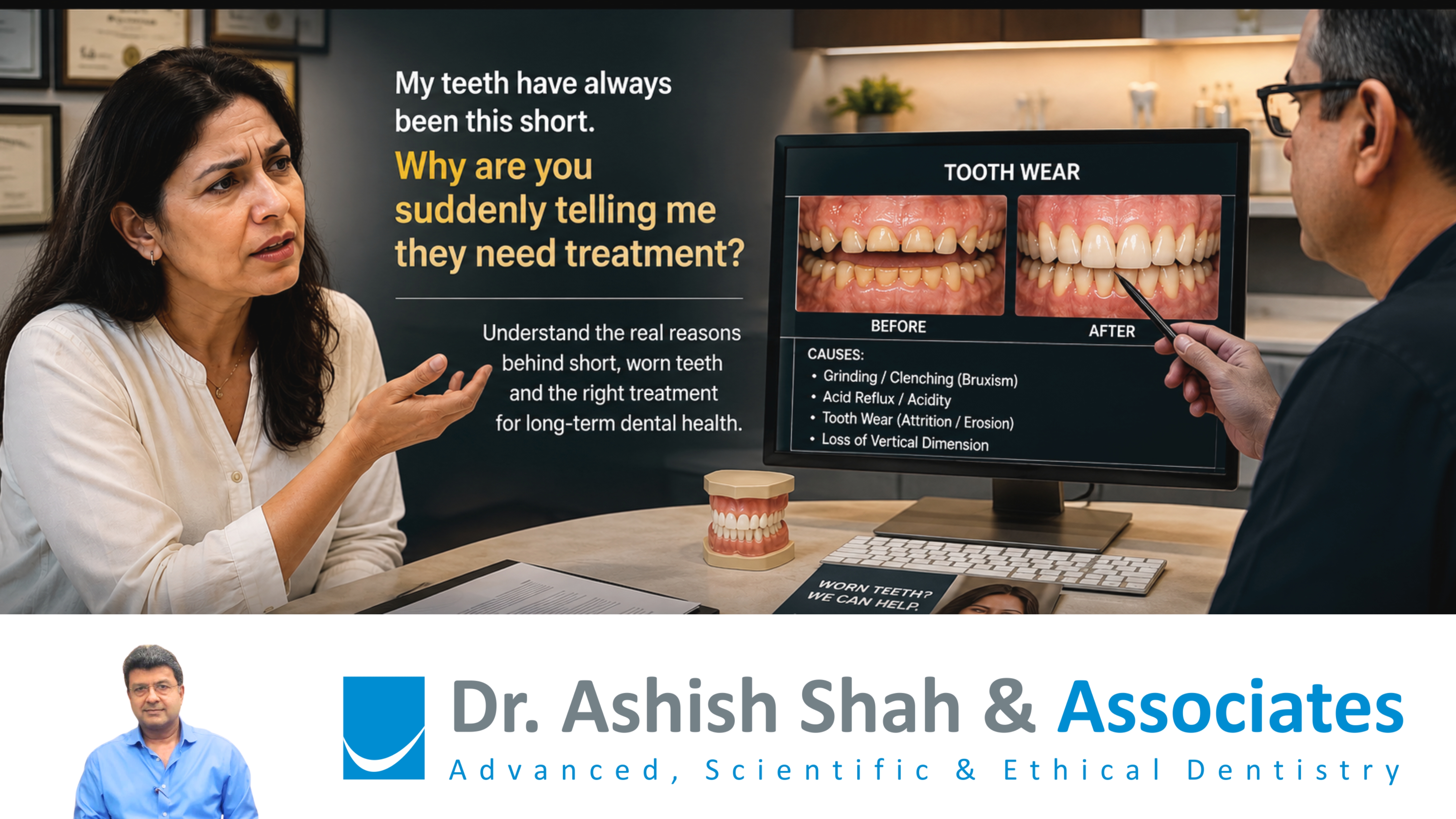
“My Teeth Have Always Been Like This. Why Do They Need Treatment Now?”
This is one of the most important questions patients ask.
If your teeth have gradually become shorter or more worn, you may have adapted to the change over many years.
You may therefore think:
“If I have been living with these teeth for years, why should I suddenly do something about them?”
The answer depends on whether the condition is stable or continuing to deteriorate.
A dentist may recommend treatment not simply because your teeth look different, but because examination may show:
- Continuing tooth wear
- Loss of protective tooth structure
- Repeated fractures
- Increasing sensitivity
- Loss of functional tooth height
- Unfavourable bite relationships
- Repeated failure of restorations
The important question is not simply how your teeth look today, but where they are heading if nothing is done.
Is Full Mouth Rehabilitation Just Putting Crowns on All My Teeth?
No.
This is perhaps the biggest misconception about Full Mouth Rehabilitation.
Crowns may be an important part of treatment, but they are only one possible tool.
Depending on the condition of the teeth, treatment may include:
Minimal restoration → Onlays/overlays → Veneers → Crowns → Bridges → Implants → Implant-supported restorations
The philosophy should be:
Preserve healthy tooth structure wherever possible and restore only what needs to be restored.
A good Full Mouth Rehabilitation is therefore not about treating every tooth simply because the patient has come for a comprehensive treatment.
Do I Need Crowns, Veneers or Implants?
There is no universal answer.
Different teeth may require different solutions.
Crowns
Crowns may be appropriate when a tooth has lost substantial structure, is heavily restored, fractured or requires protection from further damage.
Veneers
Veneers may be appropriate in selected situations where the underlying tooth structure is reasonably healthy but changes in shape, colour or appearance are required.
They are generally not a substitute for crowns on severely damaged teeth.
Implants
Implants may be considered when a tooth is missing or cannot be predictably saved.
An implant replaces the root portion of the missing tooth and supports a crown, bridge or other prosthesis.
Bridges
A bridge may sometimes be an appropriate way of replacing one or more missing teeth, depending on the condition and position of the neighbouring teeth.
Conservative restorations
In some teeth, an onlay, overlay or other more conservative restoration may be preferable to a full crown.
The treatment should therefore be tooth-specific and patient-specific.
Why Does the Bite Matter So Much?
Your teeth do not work independently.
They work together as a system.
Every time you chew, swallow, speak or clench, forces are transferred through the teeth and supporting structures.
If multiple teeth are being rebuilt, the relationship between the upper and lower teeth becomes extremely important.
The dentist may therefore need to evaluate:
- How the teeth meet
- Available space
- Tooth height
- Jaw position
- Tooth wear
- Muscle activity
- Grinding or clenching
- Existing restorations
- The position of missing teeth
The goal is not simply to make every tooth look beautiful.
It is to make the entire system function together.
Why Can’t I Just Repair the Teeth That Are Hurting?
Sometimes you can.
But sometimes treating only the tooth that is currently causing a problem may provide only a temporary solution.
For example, imagine a mouth in which:
- Several teeth are severely worn
- The bite has changed
- Some teeth have already fractured
- Other teeth have large old restorations
- Several teeth are missing
Repairing one broken tooth without considering the rest of the system may leave the underlying forces unchanged.
The newly restored tooth may then be exposed to the same environment that contributed to the original problem.
Therefore, the dentist needs to distinguish between:
“What is hurting today?”
and
“What is causing the mouth to become unstable?”
They are not always the same question.
Can Severely Worn or Broken Teeth Really Be Rebuilt?
In many situations, yes.
But the extent to which teeth can be rebuilt depends on:
- Remaining tooth structure
- Root condition
- Gum and bone support
- Presence of decay
- Previous root canal treatment
- Fractures
- Bite
- Tooth position
- Overall oral health
Some teeth can be restored conservatively.
Some may require crowns.
Some may require root canal treatment before restoration.
Some may be beyond predictable restoration and may need extraction and replacement with an implant or another appropriate option.
The objective is always to determine which teeth can be predictably saved and which cannot.
What If Some Teeth Cannot Be Saved?
Full Mouth Rehabilitation does not mean that every existing tooth must be preserved at any cost.
Sometimes a tooth has such extensive damage that attempting to save it may provide an unpredictable result.
In such situations, extraction and replacement may be more appropriate.
Depending on the circumstances, the missing tooth may be replaced with:
- An implant-supported crown
- An implant-supported bridge
- A conventional bridge
- A removable prosthesis
- Another appropriate restorative solution
The decision should be based on prognosis, function, biology and long-term stability, not simply on the desire to preserve every tooth.
How Is Full Mouth Rehabilitation Scientifically Planned?
A comprehensive rehabilitation should begin with diagnosis — not treatment.
The planning process may involve:
1. Clinical examination
The teeth, gums, existing restorations, bite and overall oral condition are evaluated.
2. Photographic records
Clinical photographs help document the existing condition and provide a reference during treatment.
3. Digital scans
Intraoral scanning can provide accurate digital records of the teeth and their relationship.
4. X-rays and CBCT where indicated
These help evaluate roots, bone, existing restorations, infections and anatomical structures.
5. Bite analysis
The existing relationship between the upper and lower teeth is assessed.
6. Evaluation of tooth wear
The pattern and extent of wear can provide important information about function and parafunction.
7. Diagnostic planning
The dentist determines what needs to be preserved, restored, replaced or monitored.
8. Digital or physical planning
Depending on the case, digital design, diagnostic wax-ups, mock-ups or provisional restorations may be used to evaluate the proposed reconstruction.
9. Final treatment sequence
Only after the above information is understood should the sequence of treatment be established.
Why Do Different Dentists Give Completely Different Treatment Plans?
This can be extremely confusing for patients.
One dentist may recommend:
“Just replace these two teeth.”
Another may recommend:
“You need crowns on many teeth.”
Someone else may suggest:
“Remove these teeth and replace them with implants.”
Why can this happen?
Because Full Mouth Rehabilitation involves clinical judgement and treatment philosophy, not simply a mathematical formula.
Different dentists may differ in their assessment of:
- Which teeth are restorable
- The prognosis of existing teeth
- The importance of the bite
- The degree of tooth wear
- How much tooth structure should be preserved
- Whether a tooth should be restored or replaced
- The sequence of treatment
- The acceptable level of risk
This is why it is important to understand the reasoning behind a treatment plan, rather than simply comparing the number of crowns or implants being proposed.
Is There Only One Correct Full Mouth Rehabilitation Plan?
Not necessarily.
There may sometimes be more than one clinically acceptable approach.
For example, depending on the situation, a missing tooth might be replaced with an implant or a bridge.
Similarly, a damaged tooth might be restored with a crown, an onlay or another restoration depending on how much healthy tooth structure remains.
However, not every option is equally suitable for every patient.
The dentist’s responsibility is to explain the appropriate options and their advantages, limitations, risks and long-term implications.
What Is the Philosophy Behind Full Mouth Rehabilitation?
Our philosophy is simple:
Do not treat teeth independently when the problem involves the entire dental system.
At the same time:
Do not treat healthy teeth unnecessarily just because a comprehensive treatment is being planned.
The objective is to find the right balance between:
Preservation + Function + Biology + Aesthetics + Long-term Stability
This means asking:
- What can be preserved?
- What must be restored?
- What should be replaced?
- What can be left alone?
- What is likely to remain stable?
- What could fail if left untreated?
Can Full Mouth Rehabilitation Be Done Without Implants?
Yes.
Implants are an important option for replacing missing teeth, but Full Mouth Rehabilitation does not automatically mean implants.
Depending on the condition of the teeth, a rehabilitation may be completed using combinations of:
- Crowns
- Onlays
- Overlays
- Veneers
- Bridges
- Conservative restorations
Implants become relevant when teeth are missing or when a tooth cannot be predictably retained.
Can Full Mouth Rehabilitation Be Done With Implants?
Yes.
In some patients, implants form an important part of the rehabilitation.
For example, a patient may have:
- Some healthy teeth that should be preserved
- Some severely damaged teeth that require restoration
- Some teeth that cannot be saved
- Several missing teeth
The final rehabilitation may therefore combine natural teeth and implant-supported restorations.
The objective is not to replace everything with implants.
It is to determine where natural teeth can be predictably retained and where implants provide a better long-term solution.
How Long Does Full Mouth Rehabilitation Take?
There is no single duration that applies to every patient.
Treatment time depends on:
- Number of teeth involved
- Severity of tooth wear
- Number of missing teeth
- Need for root canal treatment
- Gum treatment
- Extractions
- Bone augmentation
- Implant placement
- Healing requirements
- Temporary restorations
- Laboratory procedures
- Complexity of the final restoration
Some rehabilitations can be completed in a relatively small number of carefully planned visits.
Others require several stages separated by healing periods.
The important principle is:
The treatment should be planned around the biology and requirements of the case rather than around an arbitrary number of appointments.
Can Full Mouth Rehabilitation Be Completed Quickly?
Sometimes, yes — but fast is not necessarily better.
Modern digital dentistry, CAD/CAM technology, digital scanning and advanced laboratory workflows can significantly improve planning and efficiency.
However, some biological processes cannot simply be compressed.
For example, when bone or soft tissue needs to heal, adequate healing time may be essential.
The goal should therefore be:
Efficient treatment without compromising biological or clinical predictability.
What Role Does Digital Dentistry Play?
Digital technology can be extremely useful in comprehensive rehabilitation.
Depending on the case, digital tools may assist with:
- Intraoral scanning
- Digital study models
- Bite records
- Smile analysis
- Treatment planning
- Diagnostic design
- CAD/CAM restorations
- Communication with the laboratory
- Implant planning
- Guided surgery
- Provisional restoration design
- Comparison of the original and proposed dental condition
But technology is a tool.
It does not replace diagnosis or clinical judgement.
A beautifully designed digital plan is useful only when it is based on a sound understanding of the patient’s biology and function.
Will My New Teeth Look Natural?
That should be one of the goals.
However, natural-looking dentistry is not simply about choosing a particular shade of ceramic.
The appearance depends on:
- Tooth proportions
- Shape
- Length
- Position
- Surface characteristics
- Colour
- Gum contours
- Relationship between teeth
- Smile line
- Facial proportions
The restoration should ideally look like it belongs within your face and smile, rather than looking like a set of artificial teeth placed into the mouth.
Will My New Teeth Feel Like Natural Teeth?
There is an adaptation period.
Your brain, muscles, tongue and chewing system have been accustomed to your existing teeth for many years.
After reconstruction, you may initially notice differences in:
- Tooth length
- Contact between teeth
- Speech
- Chewing
- Lip and tongue position
- Bite sensation
Most patients gradually adapt, but the extent and duration vary.
This is another reason why planning the proposed tooth position and bite before definitive treatment is important.
What Happens If I Do Nothing?
This depends entirely on the condition of your teeth.
Some problems may remain stable for years.
Others may progressively deteriorate.
If teeth are already showing:
- Progressive wear
- Repeated fractures
- Increasing sensitivity
- Recurrent decay
- Failing restorations
- Loss of tooth structure
- Increasing difficulty chewing
then simply waiting may allow the problem to progress.
Sometimes delaying treatment can result in:
less remaining tooth structure → fewer treatment options → greater complexity → greater cost
However, this does not mean that every patient needs immediate comprehensive treatment.
The correct approach is to determine what is stable, what is deteriorating and what actually needs intervention.
What About the Cost of Full Mouth Rehabilitation?
There is no meaningful “standard price” for Full Mouth Rehabilitation.
The cost depends on what your individual treatment requires.
Factors may include:
- Number of teeth treated
- Type of restorations
- Number of implants
- Bone augmentation
- Root canal treatment
- Gum treatment
- Laboratory procedures
- Digital planning
- Temporary restorations
- Complexity of the bite reconstruction
- Materials selected
- Number of treatment stages
This is why a quotation based only on “cost per crown” or “cost per implant” can be misleading.
A comprehensive treatment plan should explain what is being done, why it is being done and what is included.
Why Is Full Mouth Rehabilitation Expensive Compared With Treating One Tooth?
Because you are not simply paying for a number of crowns.
A comprehensive rehabilitation may involve:
Diagnosis + Records + Planning + Digital Design + Clinical Treatment + Laboratory Work + Provisionalisation + Implant Surgery + Restorations + Follow-up
The greater the number of interacting variables, the greater the planning requirement.
The value is therefore not simply in the materials used.
It is in the diagnosis, planning, execution and coordination of the entire rehabilitation.
Will I Need Temporary Teeth?
In many comprehensive cases, temporary or provisional restorations are extremely useful.
They can allow the dentist and patient to evaluate:
- Tooth shape
- Tooth length
- Smile
- Speech
- Bite
- Chewing
- Comfort
- Aesthetic expectations
They may also allow the dental team to make adjustments before the definitive restorations are fabricated.
This can be particularly important when changing the bite or rebuilding severely worn teeth.
What Happens After the Treatment Is Completed?
Full Mouth Rehabilitation is not necessarily the end of treatment.
It is the beginning of a maintenance phase.
Even excellent restorations are exposed to:
- Chewing forces
- Grinding and clenching
- Oral bacteria
- Acids
- Dietary habits
- Changes in gum health
- Normal wear and tear
Regular professional review and good home care are therefore important.
Depending on the individual case, maintenance may include:
- Periodic examinations
- Professional cleaning
- Monitoring of gums
- Evaluation of restorations
- Bite evaluation
- Night-time protection where indicated
- Radiographic review where required
- Reinforcement of oral hygiene
How Long Should Full Mouth Rehabilitation Last?
There is no honest way to promise that every rehabilitation will last a particular number of years.
Longevity depends on:
- Quality and condition of the underlying teeth
- Gum and bone health
- Bite
- Grinding or clenching
- Oral hygiene
- Diet
- Type and quality of restoration
- Clinical execution
- Laboratory quality
- Regular maintenance
- Patient habits
A properly planned rehabilitation can provide many years of function, but it should never be presented as maintenance-free or guaranteed to last forever.
What Should I Ask Before Starting Full Mouth Rehabilitation?
Before committing to treatment, you should be able to understand:
About the diagnosis
- What exactly is wrong with my teeth?
- Which teeth are healthy?
- Which teeth are compromised?
- Which problems are progressing?
- What happens if I do nothing?
About the treatment
- Why does each tooth need treatment?
- Which teeth can be preserved?
- Which teeth need crowns?
- Which might need veneers or onlays?
- Which teeth cannot be saved?
- Do I need implants?
- Are there alternatives?
About the bite
- Has my bite changed?
- Why does my bite need to be changed?
- How will the new bite be determined?
- Will I need temporary restorations to test it?
About the process
- How will the treatment be planned?
- What diagnostic records will be taken?
- How many stages are involved?
- How many visits are expected?
- How much time will the entire process require?
About the financial aspect
- What is included in the treatment?
- Are temporary restorations included?
- Are laboratory charges included?
- Are implants and their final restorations included?
- What additional procedures might become necessary?
About the future
- How do I maintain the result?
- Will I need a night guard?
- How often should I return for review?
- What happens if a restoration chips, fractures or fails?
The Most Important Question
After hearing about Full Mouth Rehabilitation, many patients ask:
“Do I really need all this treatment?”
That is a completely reasonable question.
The answer is never:
“Because I am the dentist and I am telling you to do it.”
Instead,
What is healthy → What is compromised → What is deteriorating → What can be preserved → What needs treatment → What happens if it is not treated → What options are available.
Only then can you make an informed decision.
Full Mouth Rehabilitation Is Not About Doing More Dentistry
This is perhaps the most important principle to understand.
Comprehensive treatment does not mean excessive treatment.
A well-planned Full Mouth Rehabilitation should aim to:
Preserve what can be preserved.
Remove or replace what cannot be predictably maintained.
Restore function.
Protect remaining tooth structure.
Re-establish a stable bite where required.
Improve aesthetics without unnecessarily sacrificing healthy tooth structure.
Create a result that can be maintained over the long term.
Our Philosophy
At Dr Ashish Shah & Associates, we believe that complex dental problems should first be understood, then planned, and only then treated.
We do not believe that every patient with worn, broken or missing teeth needs the same treatment.
Some patients may require a few carefully selected restorations.
Others may require extensive reconstruction involving crowns, veneers, implants and bite rehabilitation.
The treatment should be determined by the patient’s condition — not by a predetermined package.
The aim is not to perform the maximum amount of dentistry.
The aim is to perform the right dentistry, in the right sequence, for the right reasons.
In Simple Terms
Think of Full Mouth Rehabilitation as rebuilding a house rather than simply repairing one room.
If one tile is broken, replacing the tile may be enough.
But if the foundation, walls, electrical system and plumbing are all interacting with one another, repeatedly repairing individual areas may not solve the underlying problem.
Similarly, when multiple dental problems interact, treating teeth one at a time may not always provide the most predictable long-term solution.
The first step is therefore not:
“How many crowns do I need?”
It is:
“What is happening to my mouth, why is it happening, what can be preserved, and what is the most predictable way to restore it?”
Once those questions are answered, the treatment plan becomes much easier to understand.
Full Mouth Rehabilitation is ultimately not about rebuilding every tooth.
It is about rebuilding a healthy, functional and stable dental system — while preserving as much of what is naturally yours as possible.