
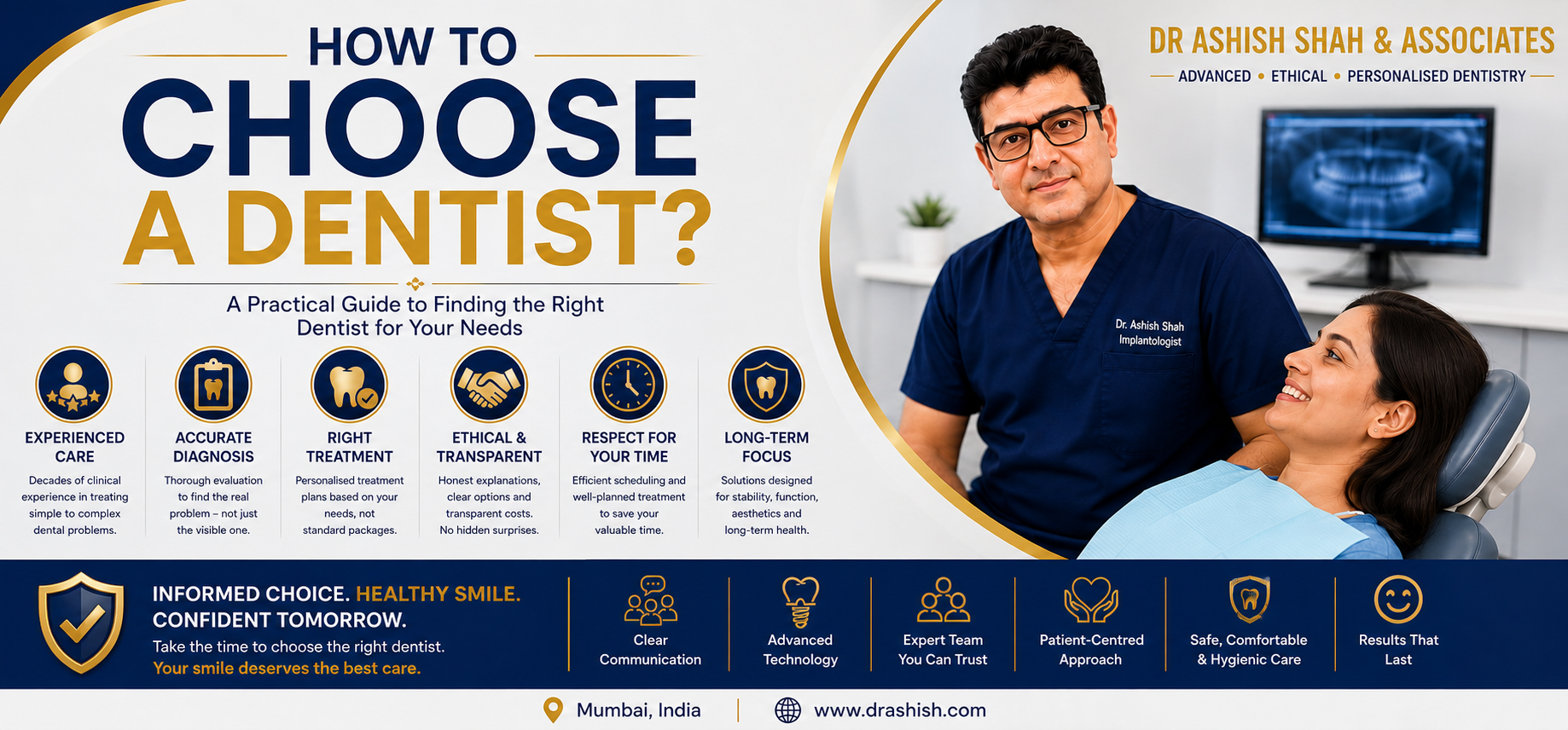
A patient today faces a very different problem from the one patients faced 30–35 years ago. There are far more treatment choices, more technology, more specialisations, and more ways in which treatment can be planned. So the question is no longer simply, “Which dentist is closest to me?” It is:
“How do I choose the right dentist for my particular needs—and how do I know that I am making a well-informed decision?”
HOW TO CHOOSE A DENTIST
A practical guide to choosing the right dentist for you
Choosing a dentist used to be relatively simple.
Thirty-five years ago, in a city like Mumbai, the dentist closest to your home was often the obvious choice. Dentistry involved fewer treatment options, patients generally needed to visit their dentist repeatedly, and convenience played a major role.
But dentistry has changed enormously.
Today, there are dental implants, advanced restorative dentistry, full-mouth rehabilitation, digital dentistry, CBCT-based diagnosis and planning, microscopic procedures, advanced materials, complex gum and bone procedures, cosmetic dentistry and many different ways of treating the same dental problem.
So how do you choose the right dentist today?
The answer is not simply “the most famous dentist,” “the nearest dentist,” or “the one who charges the least.”
The better question is:
Does this dentist have the knowledge, experience, team, technology, systems and approach required to understand my problem and provide the right treatment for my particular situation?
Here are some questions that can help you make that decision.
1. Is the dentist qualified to treat my particular problem?
Not every dental problem requires a specialist.
But increasingly, dental treatment can become complex, and different areas of dentistry require different levels of training and experience.
Ask yourself:
Does the dentist have appropriate postgraduate or specialist training for the type of treatment I require?
A dentist’s qualification should be considered along with their actual experience in treating similar cases.
2. How much experience does the dentist have?
Experience matters because dentistry is not only about knowing what is described in a textbook.
Over many years, a dentist sees:
- straightforward cases
- unusual cases
- complications
- treatment failures
- different types of patients
- different materials
- different treatment approaches
- situations where the original diagnosis was incorrect
A dentist with many years of clinical experience has had the opportunity to learn not only what works, but also what can go wrong and why.
Is experience the only thing that matters?
No.
Experience should be combined with current knowledge, continuing education and the ability to use modern diagnostic and treatment methods appropriately.
3. Does the dentist have a specialist area of expertise?
Dentistry today is broad.
A dentist may be excellent at routine general dentistry but may not necessarily be the right person for a complex implant rehabilitation, extensive reconstruction, difficult root canal, major gum problem or complicated restorative case.
Ask:
“Is this dentist’s training and experience appropriate for the complexity of my problem?”
This is particularly important when treatment involves several teeth, previous treatment failures or multiple specialities.
4. Does the dentist diagnose before recommending treatment?
This may be one of the most important questions of all.
A good consultation should begin with understanding the problem.
Not:
“Which treatment would you like?”
but:
“What is actually wrong, why has it happened, and what are the possible ways of managing it?”
The diagnosis should form the basis of the treatment plan.
5. Does the dentist explain WHY a particular treatment is being recommended?
A treatment recommendation should make sense to you.
You should be able to understand:
- What is wrong?
- Why did it happen?
- What are the possible treatment options?
- Why is one option being recommended?
- What are the advantages and limitations?
- What happens if treatment is postponed?
You don’t need to become a dentist.
But you should understand the reasoning behind an important treatment decision.
6. Are alternative treatments discussed?
Sometimes there is only one sensible option.
But in many situations, there may be several reasonable approaches.
For example, a missing tooth might potentially be managed with:
- an implant-supported restoration
- a bridge
- a removable option
- or, in some circumstances, no immediate replacement
The right choice depends on the individual situation.
A good dentist should explain the relevant alternatives, rather than making you feel that there is only one possible treatment.
7. Does the dentist think about the long term?
A treatment can look successful today and still create problems several years later.
Ask:
“How is this treatment expected to perform over the long term?”
The dentist should consider:
- remaining tooth structure
- bite and forces
- gum health
- bone support
- quality of the restoration
- maintenance
- the patient’s habits
- future treatment requirements
The goal should not simply be to complete today’s procedure.
It should be to create a result that can be maintained and looked after for many years.
8. Does the dentist use technology appropriately?
Modern dentistry offers powerful diagnostic and treatment tools.
These may include:
- digital radiography
- CBCT
- intraoral scanning
- digital photographs
- digital treatment planning
- magnification and microscopes
- computer-assisted implant planning
- advanced sterilisation and infection-control systems
- modern restorative materials
But there is an important question:
Does the dentist use technology because it genuinely improves diagnosis or treatment—or simply because the technology is available?
Technology should support clinical judgement, not replace it.
9. Does the dentist have access to a capable team?
This is often overlooked.
Complex dentistry is increasingly a team effort.
A practice may involve specialists and trained associate dentists with expertise in areas such as:
- restorative dentistry
- prosthodontics
- endodontics
- periodontics
- implant dentistry
- oral surgery
- orthodontics
- dental hygiene and maintenance
The important question is not simply:
“Does the clinic have many dentists?”
It is:
“Are the people working with the principal dentist properly qualified, experienced and capable of handling my treatment?”
10. What happens if my dentist is unavailable?
This is a very practical question.
What happens if the principal dentist is:
- travelling
- attending a conference
- unwell
- unavailable for a few days
- unable to attend an unexpected problem?
A well-organised practice should have appropriate systems and capable professionals who can assist when necessary.
This becomes particularly important during lengthy or complex treatment.
Continuity of care matters.
11. How well organised is the dental practice?
Good dentistry is not only about what happens inside the mouth.
A patient’s experience also depends on how well the organisation functions.
Ask:
- Is getting an appointment reasonably organised?
- Are appointments scheduled properly?
- Is waiting time managed?
- Are treatment records maintained?
- Are follow-ups organised?
- Are instructions communicated clearly?
- Can the clinic coordinate different stages of treatment?
- Does somebody take responsibility for keeping the treatment journey organised?
A highly skilled dentist working in a poorly organised system can still create a frustrating patient experience.
12. Does the practice respect my time?
Modern patients are busy.
Dental treatment can require several appointments, but unnecessary visits should be avoided wherever reasonably possible.
A well-planned treatment should consider:
“How can the necessary treatment be completed properly while respecting the patient’s time?”
Good planning can often reduce unnecessary appointments without compromising the quality of treatment.
13. Is the practice transparent?
Transparency builds trust.
You should feel comfortable asking:
- What exactly is being recommended?
- What will be involved?
- How many stages are expected?
- How long might treatment take?
- What are the limitations?
- What happens if something doesn’t go as planned?
- What maintenance will be required?
You should not feel that asking questions is an inconvenience.
14. Does the dentist discuss risks and limitations?
Every treatment has limitations.
No responsible dentist can guarantee that every treatment will last forever or that complications will never occur.
A trustworthy discussion should include not only:
“What can we achieve?”
but also:
“What are the risks, limitations and uncertainties?”
This allows you to make an informed decision.
15. Does the dentist show real clinical cases?
Photographs and case examples can be useful.
They can help you understand:
- the starting condition
- the diagnosis
- the treatment approach
- the stages involved
- the final result
But be careful.
A beautiful photograph alone doesn’t prove clinical expertise.
The more meaningful question is:
“Can the dentist explain why this treatment was selected and how the result was achieved?”
16. Does the dentist explain what YOU will experience?
Patients often want to know more than just the technical procedure.
You may want to know:
- Will it be uncomfortable?
- How many visits will I need?
- How long will each visit take?
- Will I be able to work afterwards?
- What can I eat?
- What should I avoid?
- What happens during healing?
- When will I receive the final restoration?
A good patient education system should answer these questions before treatment begins.
17. What happens AFTER treatment?
Treatment does not end when the procedure is completed.
A crown, bridge, implant or full-mouth rehabilitation needs maintenance.
Ask:
“What will I need to do to maintain this treatment?”
This may include:
- regular examinations
- professional cleaning
- hygiene instructions
- bite evaluation
- radiographic monitoring where indicated
- maintenance of implant-supported restorations
- replacement or repair of components when necessary
Long-term success is a partnership between the dentist and the patient.
18. Does the practice have good infection-control and sterilisation systems?
This is something patients may not always think about.
You can ask whether the practice follows proper protocols for:
- instrument sterilisation
- disinfection
- barrier protection
- handling of sterile instruments
- clinical waste management
- infection prevention
These are fundamental parts of a modern dental practice.
19. Does the staff treat patients with care and respect?
The dentist is only one part of your experience.
Think about the entire team.
Are the staff:
- courteous?
- attentive?
- organised?
- willing to answer reasonable questions?
- respectful of your privacy?
- helpful when you are anxious?
- clear about instructions and appointments?
A caring clinical environment matters, particularly when treatment involves multiple visits.
20. Does the dentist communicate in a way that you understand?
A highly qualified dentist should still be able to explain complicated dentistry in simple language.
You should not feel embarrassed to say:
“I don’t understand. Could you please explain that again?”
The consultation should be a conversation—not a lecture.
21. Does the dentist encourage questions and second opinions?
A confident clinician should not be threatened by a patient wanting to understand their options.
For major treatment, it is reasonable to ask questions and, when appropriate, seek another opinion.
The purpose of a second opinion should not simply be:
“Can I get this treatment cheaper?”
It can also be:
“Is the diagnosis correct?”
“Are there other reasonable options?”
“Does the proposed treatment make sense for my long-term dental health?”
These are much more important questions.
22. Does the dentist keep proper records?
Good clinical records are important for continuity of care.
Depending on the treatment, these may include:
- medical and dental history
- clinical photographs
- X-rays
- CBCT scans
- treatment plans
- laboratory information
- previous treatment details
- progress records
- maintenance records
Good documentation helps the dentist understand what has happened over time.
23. Does the dentist understand that every patient is different?
There is rarely one treatment that is automatically right for everyone.
Two patients may have apparently similar missing teeth but completely different:
- bone levels
- gum conditions
- bite relationships
- remaining teeth
- medical histories
- expectations
- previous treatment
- long-term requirements
Therefore:
Treatment should be individualised rather than selected simply because it is popular.
24. Does the dentist know when NOT to treat?
This is an underrated quality.
Sometimes the correct decision is to:
- monitor
- preserve a tooth
- postpone treatment
- choose a simpler option
- avoid unnecessary intervention
Good dentistry is not about doing the maximum amount of treatment.
It is about doing the appropriate treatment for the patient.
25. Does the dentist continue learning?
Dentistry continues to change.
New materials, techniques, technologies and scientific evidence become available.
Ask whether the dentist keeps up with developments through:
- continuing education
- professional courses
- conferences
- scientific literature
- specialist training
- interaction with other professionals
Experience is valuable.
Experience combined with continued learning is even more valuable.
26. Is the dentist able to handle complex treatment as a coordinated process?
Some patients don’t have a single dental problem.
They may have:
- missing teeth
- worn teeth
- gum disease
- failing crowns
- old bridges
- root-canal-treated teeth
- bite problems
- bone loss
- aesthetic concerns
In such situations, treating one tooth at a time may not always be the best approach.
The dentist should be able to step back and ask:
“What is the overall problem, and how should the different parts of treatment fit together?”
This is where comprehensive treatment planning becomes particularly important.
27. Does the dentist have a philosophy of preservation?
Whenever possible, natural teeth and healthy tissues should be respected and preserved.
The question should not simply be:
“What can we replace?”
It should first be:
“What can we preserve?”
A thoughtful treatment plan considers the least destructive appropriate option before moving towards more extensive treatment.
28. Does the practice take responsibility for the complete treatment journey?
For complex treatment, you should know:
Who is coordinating my treatment?
Who do I contact if I have a problem?
Who will explain the next stage?
Who will follow me up after treatment?
Who will maintain the result?
A well-designed system should make the patient feel that someone is keeping track of the whole journey, rather than each appointment being an isolated event.
29. Should I choose a dentist based only on reviews?
Reviews can be helpful, but they should not be the only deciding factor.
A patient may write:
“Excellent dentist, very friendly.”
That tells you something about the experience.
But it may tell you very little about the dentist’s ability to manage a complex implant rehabilitation or a difficult restorative case.
Look at the larger picture:
Qualifications + experience + clinical approach + relevant cases + technology + team + organisation + communication + patient experience.
30. Should I choose the dentist who gives me the quickest treatment?
Not necessarily.
Sometimes treatment can be completed quickly because the situation allows it.
Sometimes a complex treatment needs time.
Healing, tissue maturation, laboratory procedures, biological integration and staged treatment cannot always be shortened simply for convenience.
The better question is:
“Is the treatment timeline appropriate for my biological and clinical situation?”
31. Should I choose the dentist who recommends the most advanced treatment?
Not necessarily.
Advanced technology and advanced treatment are not automatically better.
The right question is:
“Is this technology or treatment actually appropriate for me?”
A sophisticated solution to the wrong problem is still the wrong treatment.
32. What about the overall environment of the clinic?
You may also notice:
- cleanliness
- organisation
- privacy
- professionalism
- punctuality
- communication
- staff behaviour
- how records are handled
- how treatment is explained
These things may seem unrelated to dentistry.
But together they tell you something about how the organisation functions.
33. Should I be looking for one dentist or a team?
For straightforward treatment, one dentist may be perfectly adequate.
For complex treatment, however, a coordinated team can be a significant advantage.
Different professionals may bring different areas of expertise.
The important thing is not simply the size of the team.
It is:
How well does the team work together, and who is responsible for coordinating the treatment?
34. How do I know whether I can trust the dentist?
Trust should not be based simply on personality.
Look for consistency between:
What the dentist says
What the dentist explains
What the dentist recommends
What the dentist documents
What the dentist actually does
A trustworthy dentist should be comfortable explaining both the strengths and limitations of the proposed treatment.
35. Finally, ask yourself one simple question
After your consultation, ask yourself:
“Do I understand what is wrong, what my options are, why one option has been recommended, what the treatment involves, and what I can reasonably expect in the long term?”
If the answer is yes, you are in a much better position to make an informed decision.
HOW SHOULD YOU CHOOSE A DENTIST TODAY?
Dentistry has moved a long way beyond simply treating a painful tooth.
Today, many treatments are sophisticated, interconnected and expected to function for many years.
So choosing a dentist should also go beyond:
“Who is nearest to me?”
or
“Who is the cheapest?”
Instead, consider:
Qualification
Does the dentist have appropriate training?
Experience
How much relevant clinical experience does the dentist have?
Diagnosis
Does the dentist understand the underlying problem before recommending treatment?
Treatment planning
Are alternatives, advantages, limitations and long-term implications explained?
Technology
Is modern technology being used appropriately?
Team
Are there qualified and capable professionals who can work together when required?
Continuity
What happens if the principal dentist is unavailable?
Organisation
Is the practice well managed, with good appointment and follow-up systems?
Transparency
Are you given enough information to make an informed decision?
Patient care
Does the entire team treat you with respect and attention?
Long-term thinking
Is the treatment designed not merely to look good today, but to remain healthy and functional?
Maintenance
Is there a plan for looking after the result after treatment is completed?
A FINAL THOUGHT
You don’t need to become an expert in dentistry before choosing a dentist.
That is our responsibility as dental professionals.
But you should know enough to recognise whether the person you are trusting has the appropriate knowledge, experience, systems, team and approach for your particular needs.
And perhaps the most important question is not:
“Who is the best dentist?”
There is no universally best dentist for every patient and every problem.
A better question is:
“Who is the right dentist for my particular problem, my expectations and the kind of long-term care I am looking for?”
Once you have chosen that dentist, the next step is simple:
Let the dentist examine you properly, understand your concerns, make a diagnosis, explain your options and help you decide what is appropriate for you.
That is what a good dental consultation should be about.
About Dr Ashish Shah & Associates
At Dr Ashish Shah & Associates, we believe that modern dentistry begins with understanding the patient and the problem before deciding on the treatment.
With more than 35 + years of clinical experience, Dr Ashish Shah has seen dentistry evolve from relatively straightforward individual procedures to today’s increasingly sophisticated and multidisciplinary treatment options.
Our approach is therefore centred around:
Accurate diagnosis → appropriate treatment planning → informed decision-making → skilled execution → long-term maintenance.
Where treatment is complex, a coordinated team of appropriately trained dental professionals can bring together different areas of expertise while maintaining continuity of care.
Our Patient Education section has been created to help you understand your dental condition, treatment options and the questions you should ask—before and after your consultation.
You can explore the relevant topics, watch our educational videos, read about clinical cases and then discuss your individual situation with your dentist.
Because choosing a dentist is ultimately not about choosing a name.
It is about choosing the person and the team you are prepared to trust with your dental health for the long term.