
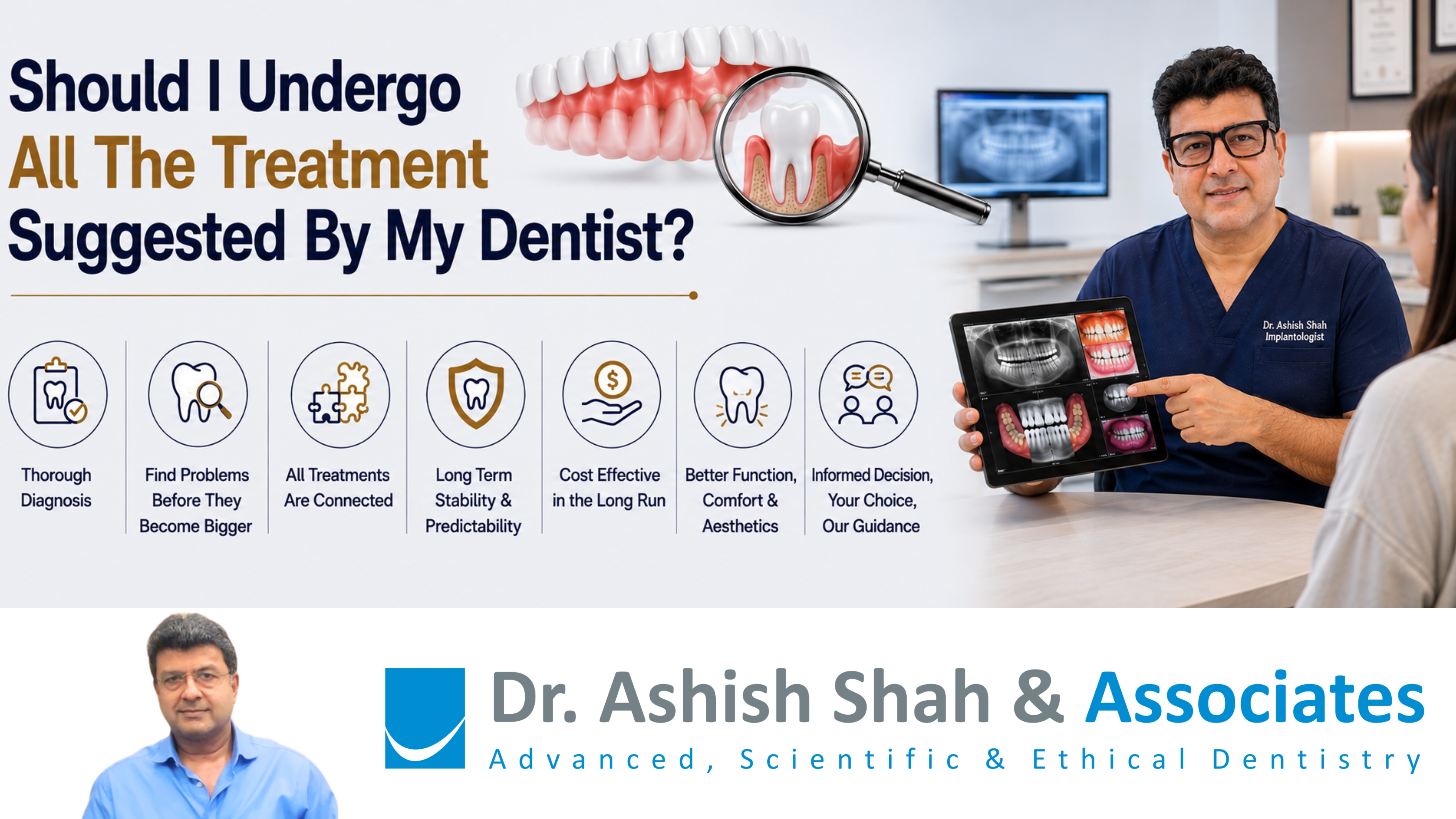
Should I Undergo All the Treatment Suggested by My Dentist?
You may have visited your dentist because of one specific problem — perhaps a painful tooth, a broken crown, a missing tooth or sensitivity — only to be told that several other teeth or areas also need attention.
Your first reaction may be:
“I came here for one problem. Why am I suddenly being told that I need so much treatment?”
This is a very reasonable question.
A thorough dental examination can sometimes reveal problems that are not causing symptoms yet. Some conditions may be developing silently, while others may affect the long-term success of the treatment you originally came seeking.
Why isn’t it always enough to treat only the tooth that is troubling me?
Dentistry is not always about treating the tooth that hurts today. The surrounding teeth, gums, bite, bone, existing restorations and the overall condition of your mouth can influence the success and longevity of treatment.
For example, if one tooth requires a crown but neighbouring teeth have significant decay, excessive wear or an unstable bite, simply treating that one tooth may solve today’s complaint without addressing the factors that caused or may continue to cause the problem.
Similarly, replacing a missing tooth with an implant may require consideration of the surrounding bone, gums, neighbouring teeth and the way your teeth come together.
This is why a comprehensive evaluation can sometimes lead to a treatment plan that is broader than the problem that brought you to the dentist.
But does that mean I should blindly undergo everything suggested?
No.
The purpose of a comprehensive treatment plan is not to convince you to undergo unnecessary treatment.
You should understand:
- What problems have been identified
- Which problems require treatment now
- Which can be monitored
- Why each treatment has been recommended
- What may happen if a problem is left untreated
- What alternatives are available
- What the expected benefits, limitations and risks are
- How the different treatments relate to one another
Informed treatment decisions should involve a discussion between the dentist and patient about the proposed treatment, its benefits and risks, alternatives, and the consequences of not proceeding. (ADA)
Why can treating only my main complaint sometimes be a problem?
Sometimes the treatment you initially seek is dependent on other conditions being addressed.
For example, a new restoration may not remain predictable if the tooth supporting it is compromised. An implant may not have an ideal long-term prognosis if important problems affecting the surrounding tissues or bite are ignored.
This does not mean that every patient needs extensive treatment.
It means that treatment should be planned according to the whole clinical situation, rather than simply responding to whichever tooth happens to be causing symptoms today.
What about the fear that the treatment will become much more expensive?
This is one of the most understandable concerns.
When patients hear a larger treatment plan, they may naturally think:
“If I had just treated the original problem, I wouldn’t have to spend so much.”
But the relevant question is not simply “How much does today’s treatment cost?”
It is:
“What treatment gives me the best reasonable chance of achieving a stable result over the long term?”
Sometimes addressing additional problems at the appropriate time can prevent repeated treatment, breakdown or the need for more extensive intervention later.
At the same time, a responsible treatment plan should distinguish between essential treatment, desirable treatment and treatment that can safely be postponed.
The decision should be based on clinical need and your individual circumstances — not simply on the desire to complete more dentistry.
What if I don’t agree with the complete treatment plan?
That is your decision.
A dentist’s responsibility is to diagnose, explain the findings, recommend appropriate treatment and explain the consequences of accepting, postponing or declining it. The patient’s responsibility is to understand the information and make an informed decision. (ADA)
You should never feel that you are being asked to “trust blindly.”
Instead, you should be able to ask:
“Why is this treatment necessary?”
“What happens if I don’t do it?”
“Can it be postponed?”
“Are there alternatives?”
“How does this treatment affect the success of the other treatment?”
These are excellent questions.
The important distinction
There is a difference between:
“You need to do everything your dentist has suggested.”
and
“You should understand the complete diagnosis before deciding which treatment you should undergo.”
The second is the approach we believe in.
Sometimes the correct treatment may be relatively simple.
Sometimes, after a comprehensive evaluation, you may discover that the problem is part of a much larger pattern involving several teeth, your gums, your bite or the overall condition of your dentition.
In such situations, treating only the symptom may provide a temporary solution without addressing the underlying problem.
Ultimately, don’t decide based only on the number of treatments suggested.
Understand why they have been suggested, how they are connected, what the alternatives are, and what the likely consequences are if they are not undertaken.
Good dentistry is not about doing more treatment.
It is about doing the right treatment, for the right reasons, at the right time — with a clear understanding between the dentist and the patient.
That is the basis of predictable, ethical and long-term dental care.