
A young patient. A trauma
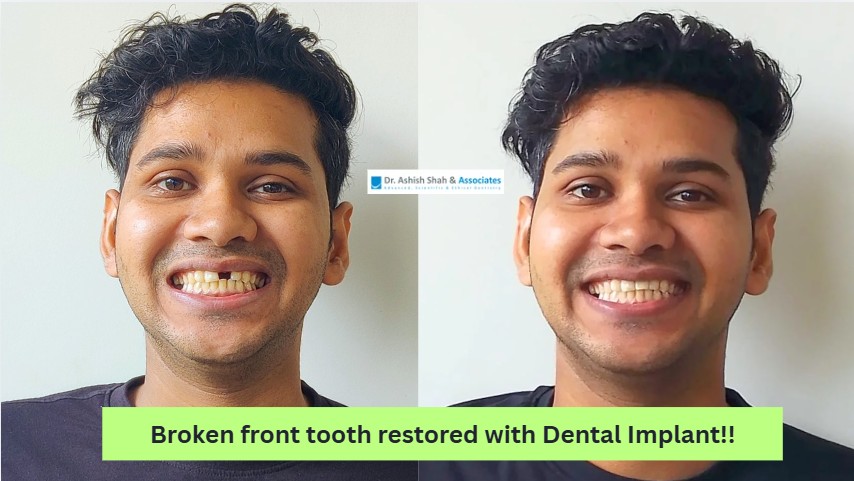
See how a traumatised front tooth with root resorption was treated with immediate implant placement, bone augmentation and an aesthetic crown.
tised front tooth. A challenging aesthetic problem.
Trauma to a front tooth can create problems that are not always visible at first glance.
In this case, a young boy presented with a history of trauma in which his front tooth had been intruded into the gum and bone. Over time, the root of the affected tooth had undergone root resorption, making the long-term prognosis of the tooth unfavourable.
The challenge was not simply to remove the damaged tooth and replace it with an implant.
The real challenge was to restore the tooth, bone, gum and appearance in a way that looked natural and maintained the correct proportions of the front teeth.
How was the case evaluated?
Before deciding on treatment, a detailed data collection and diagnostic assessment was carried out.
This included:
- Clinical photographs
- OPG
- CBCT scan
- Assessment of the affected tooth and surrounding bone
- Evaluation of the adjacent teeth
- Assessment of the gum and smile proportions
- Careful planning of the proposed implant position and final crown
The CBCT was particularly important because the three-dimensional condition of the tooth, root and surrounding bone had to be understood before deciding whether immediate implant placement was appropriate.
Why was an immediate implant considered?
After carefully evaluating the available information, it was decided that the affected tooth could not be predictably maintained.
Because of the circumstances of the case, carefully planned immediate implant placement was carried out following removal of the damaged tooth.
However, placing an implant immediately does not automatically mean that the final result will look natural.
The surrounding bone and soft tissue also need to be carefully managed.
Bone augmentation was carried out along with implant placement
The trauma and condition of the tooth had resulted in a challenging situation around the implant site.
Therefore, a bone augmentation procedure was performed along with the immediate implant placement to help develop and maintain the supporting tissues around the implant.
The objective was not merely to place an implant, but to create an appropriate foundation for the final restoration.
The importance of the gum in an aesthetic implant
One of the interesting aspects of this case was the difference in the apparent size of the affected tooth compared with the adjacent natural tooth.
Simply making the implant crown the same anatomical size as a conventional tooth could have resulted in an aesthetically disproportionate appearance.
To overcome this, gum-coloured porcelain was incorporated into the final crown.
This allowed the visible portion of the restoration to appear similar in size and proportion to the adjacent natural tooth, while helping to reproduce the appearance of the surrounding gum.
The result
The aim was to create a restoration that did not look like an implant crown placed in the mouth, but rather appeared to belong naturally with the patient’s existing teeth.
This case demonstrates an important principle in aesthetic implant dentistry:
An implant is not simply about replacing a missing tooth. The surrounding bone, gum, tooth proportions and final appearance all have to be considered together.
Watch the case
In the video, I explain this young patient’s case and the approach taken to manage the damaged front tooth, immediate implant placement, bone augmentation and the final aesthetic restoration.
What can we learn from this case?
A traumatic injury to a front tooth can involve much more than the tooth itself. Root resorption, loss or alteration of supporting tissues, bone deficiencies and changes in gum levels can all influence the eventual result.
That is why proper diagnosis and three-dimensional planning before treatment are particularly important in the front aesthetic region.
The objective should be to plan the entire restoration first and then work backwards to determine how the implant, bone and soft tissues need to be managed.